Why Two Shorter Leg Sessions Beat One Long Leg Day
Quick Answer: Splitting the same weekly leg volume across two sessions produces higher average quality per set, because you are never deep enough into a session for fatigue to degrade technique and load. It also gives you two elevated muscle protein synthesis windows instead of one, and two chances to hit a session in a week where something goes wrong. Same total sets, better sets, better attendance.
Leg day is twenty sets, ninety minutes, and by set fourteen you are moving weight that would have felt light an hour ago and did not.
Then the DOMS arrives and takes four days, and you train legs again next Monday because that is the split.
Split those twenty sets across two Wednesdays-and-Saturdays sessions of ten and almost every variable improves. This is one of the better-supported changes in training and it costs nothing.

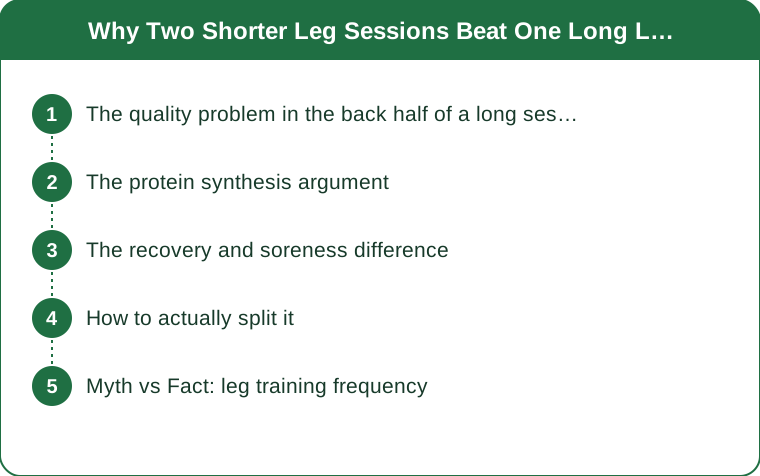
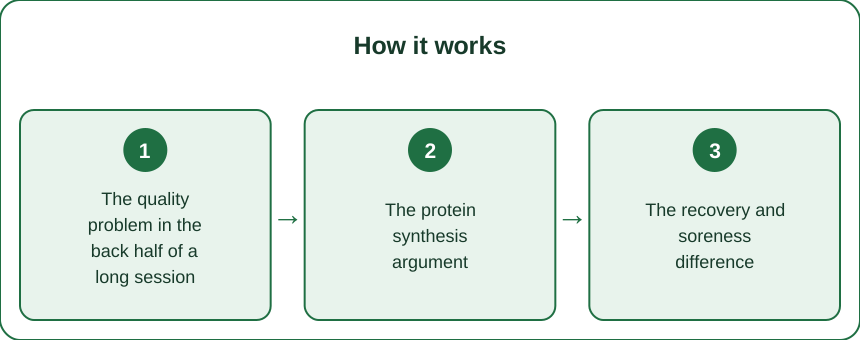
The quality problem in the back half of a long session
This is the core of the argument, and it is measurable rather than theoretical.
Performance degrades within a session in a predictable curve. By set twelve or fifteen of hard lower body work, most people are producing meaningfully less force, moving less bar speed, and using compensatory patterns they were not using at set three.
So the last third of a long leg day is not the same as the first third. Those sets look identical in a training log and they are not the same stimulus. They are lower load, lower quality, and they carry a higher injury risk because form is degrading while fatigue is high.
What splitting does: every set now happens in the first two-thirds of a session. Set eight of ten is a genuinely good set. Set eighteen of twenty is not.
The counting trap: if you write down twenty sets and eight of them were compromised, your log says twenty and your body received something closer to fourteen useful ones. Splitting means twenty written and roughly twenty received.
And the load follows. Most people find they can use noticeably heavier weight on the same exercise when it is placed at set five rather than set fifteen.
The protein synthesis argument
Resistance training elevates muscle protein synthesis — the process that actually builds tissue — for a window after the session.
The commonly cited duration for trained individuals is roughly 24 to 48 hours, with the peak in the first day and a decline after.
Train legs once a week: one elevated window, then four or five days at baseline.
Train legs twice a week: two windows, meaningfully more total time in an elevated state across the week.
The research on frequency generally finds that when total volume is equated, higher frequency is either equal or modestly better for hypertrophy, with the clearest advantages in trained lifters and in strength outcomes. Nobody has found that lower frequency is better at matched volume, which is the practical point.
Where the effect is largest: strength and skill. Squatting twice a week means twice as much practice of the squat pattern, and squatting is a skill as much as a capacity. Technical improvement follows frequency far more than it follows volume.

The recovery and soreness difference
This is the benefit people notice first and it changes adherence considerably.
A twenty-set leg session produces substantial DOMS, often peaking at 48 hours and lingering to 72 or 96. During which you walk down stairs badly, sleep worse, and skip anything that involves your legs.
Two ten-set sessions produce noticeably less soreness each time, because the volume per session is what drives most of the muscle damage. You are functional the next day.
Why that matters beyond comfort:
- You actually do the other training in your week. A leg day that wrecks you for three days silently removes your running, your walking and your second session.
- Your daily step count does not collapse for half the week.
- You are more likely to show up, because the session you are anticipating is forty-five minutes rather than ninety.
And it fits real life better. Finding two forty-five minute slots is considerably easier than finding one ninety-minute one, and a forty-five minute session is much more likely to survive a busy week intact.
How to actually split it
The simplest version: split by movement pattern.
Session A — squat-dominant. Back squat or goblet squat, split squat or lunge, leg extension or step-up, calves.
Session B — hinge-dominant. Romanian deadlift or hip thrust, hamstring curl, single-leg deadlift, calves again.
Why this works: it distributes the fatigue across different tissues, and the two sessions do not compete with each other for recovery the way two identical squat sessions would.
Spacing: aim for 48 to 72 hours between them. Monday and Thursday, or Tuesday and Friday. Back-to-back days defeats the purpose entirely.
Volume per session: 8 to 12 hard sets of direct lower body work is a productive range for most people. If your current leg day is twenty sets, ten and ten is the obvious split.
Calves twice, deliberately. Calves respond well to frequency and are barely fatiguing, so include them in both sessions.
One thing to avoid: do not turn the split into an excuse to increase total volume. Ten and ten, not fifteen and fifteen. The gain here comes from quality, and adding volume on top reintroduces exactly the fatigue you removed.
This is general information, not coaching. If you have a knee, hip or back issue, get individual guidance before restructuring your training.
Myth vs Fact: leg training frequency
Myth: You need a full week to recover legs. Fact: From a well-designed ten-set session, most people are recovered in 48 to 72 hours. The week-long recovery is a response to twenty-set sessions, which is a problem the split solves rather than a fixed requirement.
Myth: More frequency means more overtraining risk. Fact: At matched total volume, frequency is not the variable that drives overtraining. Total volume and intensity are. Two moderate sessions are generally easier to recover from than one enormous one.
Myth: Higher frequency only works for advanced lifters. Fact: Beginners arguably benefit more, because frequency drives skill acquisition and beginners have the most technique to acquire.
Myth: If I am not sore, it did not work. Fact: Soreness reflects unaccustomed damage, not adaptation. Trained lifters progressing well are often barely sore. Judging a session by DOMS is one of the most persistent mistakes in training.
Myth: You cannot go heavy twice a week. Fact: You can, and it is standard practice in strength sport. What you cannot do is go to failure on everything twice a week. Keep most sets one to three reps short of failure and twice weekly is entirely sustainable.
TL;DR:
- In a twenty-set leg day, the last third is degraded by fatigue — same log entry, worse stimulus, higher injury risk.
- Splitting means every set falls in the first two-thirds of a session, so the load and the quality both go up.
- Two sessions give you two muscle protein synthesis windows and twice the practice of the movement pattern.
- Less soreness per session means you actually do the rest of your week’s training and walking.
- Split squat-dominant and hinge-dominant, 48 to 72 hours apart, 8 to 12 hard sets each — and resist adding volume on top.
Same twenty sets. Two Tuesdays instead of one Monday. Almost everything that matters improves, and you can walk down the stairs on Wednesday.
Keep Reading
This article is for general informational and styling purposes only. Fit, sizing, and product availability may vary.