Why Your Leg Day Soreness Moved to a Different Muscle
Quick Answer: Soreness follows the muscle that did the most eccentric work at the longest muscle length. If it moved, something about your execution changed - usually depth, tempo, foot position, or how far forward your torso travels. Common causes are a deeper squat shifting work to the glutes and adductors, a slower eccentric increasing hamstring involvement in hinges, new shoes changing ankle position, or fatigue causing your torso to lean further forward. Soreness location is a genuinely useful feedback signal, and it is one most people ignore.
A change in where you are sore is information. It is rarely a problem on its own.

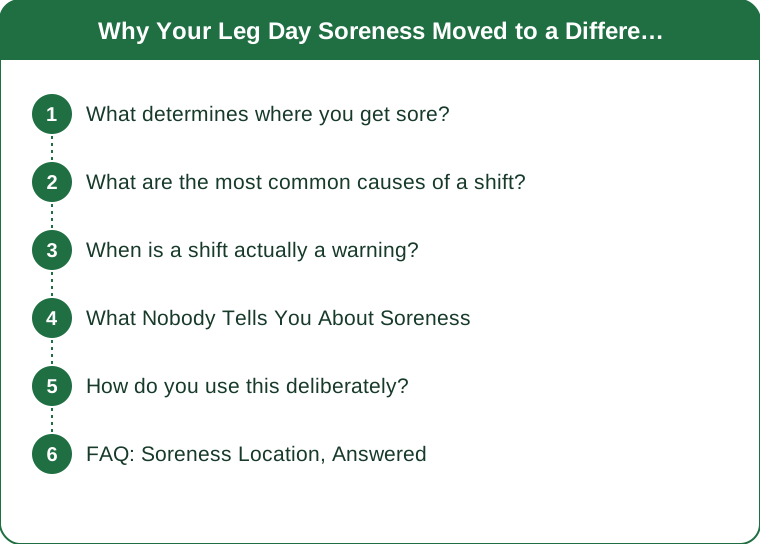
What determines where you get sore?
Eccentric loading at long muscle lengths produces the most soreness. The lowering phase, in a stretched position, is the specific combination.
That is why Romanian deadlifts make hamstrings sore and leg curls mostly do not, despite training the same muscle - one loads the hamstring long, the other does not.
Depth changes which muscle is long at the bottom. A deeper squat puts the glutes and adductors into a longer position, so soreness migrates there.
Torso angle changes the balance between quads and posterior chain. More forward lean means more hip contribution, more hamstring and glute work, less quad.
Tempo changes total eccentric time. A three-second lowering phase produces substantially more soreness than a one-second one at identical load.
And novelty matters most of all. Any new movement, or an old one done differently, produces disproportionate soreness for the first two or three sessions regardless of the muscle.
What are the most common causes of a shift?
New shoes. A change in heel height alters ankle range, which alters how much the knee travels forward, which alters the quad-to-hip balance. Flat shoes shift work toward the posterior chain; raised heels shift it toward the quads.
You got better at hinging. People who learn to hinge properly suddenly get hamstring soreness where they used to get lower back tightness, and that is a good sign rather than a bad one.
Depth changed without you noticing. Mobility improves over months, and a squat that goes an inch deeper redistributes work meaningfully.
Fatigue changed your form mid-session. Later sets with more forward lean load the posterior chain more, so soreness reflects your last sets rather than your first.
Bar position moved. A slightly lower bar on the back changes torso angle and therefore muscle contribution.
And a stronger prime mover shifts work. As quads get stronger relative to glutes, the pattern of contribution changes, and soreness follows.
When is a shift actually a warning?
Soreness that is sharply localised to one point rather than diffuse across a muscle belly. Diffuse muscle soreness is normal; a specific point is worth attention.
Soreness near a joint or a tendon insertion rather than in the muscle. Hamstring soreness high at the sit bone, or knee-adjacent quad pain, is a different category.
One-sided soreness after a two-sided exercise. Some asymmetry is normal; consistent one-sided soreness suggests a compensation worth investigating.
Soreness that persists beyond about five days, or that gets worse rather than better after day two.
Severe soreness with dark urine, significant swelling, or a marked loss of range needs urgent medical attention rather than a rest day.
This is general information, not medical advice. Sharp pain during a lift, as opposed to soreness afterwards, is always a stop signal.

What Nobody Tells You About Soreness
Soreness is a poor measure of session quality. It correlates with novelty and eccentric load, not with muscle growth or strength gain. Sessions that make you very sore are often just unfamiliar.
It decreases as you adapt, and that is not a plateau. The repeated bout effect means the same session produces less soreness within one or two exposures, and people frequently misread this as the exercise having stopped working.
The second session of the week is usually less sore than the first, even when it is harder, for the same reason.
Cold weather changes perception. People report more stiffness in cold months, and cold, static muscle feels worse than warm moving muscle regardless of what you did.
Soreness peaks at twenty-four to seventy-two hours, so the day after a session is a bad time to judge it.
And light movement helps. Walking, cycling, or an easy repeat of the movement pattern reduces soreness more effectively than rest, stretching, or most recovery gadgets.
How do you use this deliberately?
Use soreness location to check whether you executed as intended. If you meant to load the hamstrings and your quads are sore, your hinge probably became a squat.
Film one set every few weeks. Depth, torso angle, and bar path drift slowly and are invisible from inside the movement.
Note shoes, depth, and tempo in your log. These are the three variables that most commonly change without deliberate intent.
If you want a specific muscle to work harder, lengthen it under load. More depth for the glutes, more hip flexion for the hamstrings, more knee travel for the quads.
Do not chase soreness. Adding novelty to feel sore produces soreness without producing progress, and it interferes with the next session.
And judge a programme by loads lifted over weeks, not by how you feel the next morning.
FAQ: Soreness Location, Answered
Does soreness mean a good workout?
No. It tracks novelty and eccentric loading rather than growth or strength. Progression in load and reps is the better measure.
Why am I not sore anymore from the same session?
The repeated bout effect - your muscles adapt to a given stimulus within one or two exposures. It does not mean the session stopped working.
Why did my soreness move to my hamstrings?
Usually more forward torso lean, a slower eccentric, flatter shoes, or an improved hinge pattern. All four shift load posteriorly.
How long should soreness last?
Peak at twenty-four to seventy-two hours, resolving by about day four or five. Longer or worsening soreness warrants attention.
Should I train while sore?
Generally yes, with reduced load if needed. Light movement reduces soreness more effectively than rest.
This is general information, not medical advice.
TL;DR:
- Soreness follows eccentric loading at long muscle lengths - if it moved, your depth, tempo, torso angle, or footwear changed.
- New shoes are the most commonly missed cause: heel height changes ankle range, which changes the quad-to-hip balance.
- A shift toward the hamstrings after learning to hinge properly is a good sign, not a problem.
- Diffuse muscle soreness is normal; sharply localised pain, tendon-insertion pain, or consistent one-sided soreness is not.
- Soreness tracks novelty rather than progress - judge a programme by loads over weeks instead.
Light movement reduces soreness better than rest, stretching, or recovery gadgets.
Keep Reading
This article is for general informational and styling purposes only. Fit, sizing, and product availability may vary.