The Adductor (Inner Thigh) Training Guide Most Leg Days Skip Entirely
Quick Answer: The adductors (inner thigh muscles) are involved in nearly every lower-body movement as stabilizers but rarely get trained directly, which leaves them comparatively weak relative to the quads and glutes — direct exercises like side lunges, Copenhagen planks, sumo squats, and cable or machine adduction fill that gap and support better knee stability and lateral movement strength.
Most leg day routines hit the same three or four muscle groups on repeat, and the inner thigh — doing quiet stabilizing work in nearly every one of those exercises — never gets a direct turn.

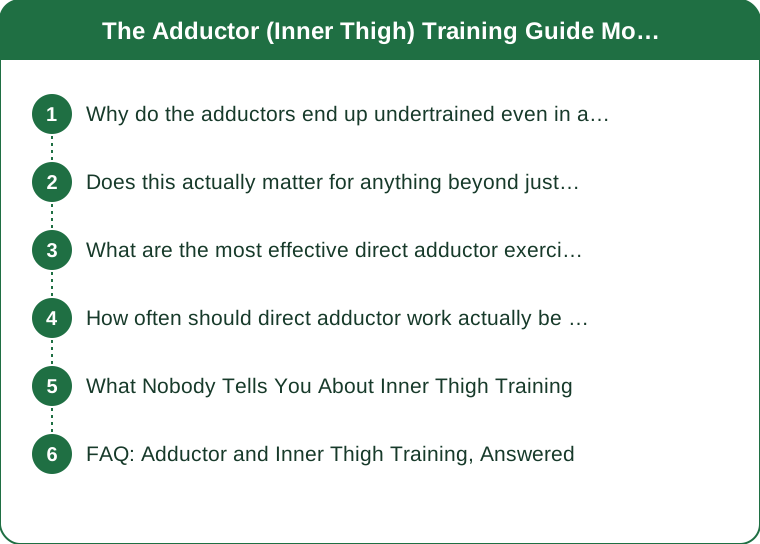
Why do the adductors end up undertrained even in a consistent leg day routine?
Most staple leg exercises — squats, lunges, deadlifts — move primarily in the sagittal plane (forward and backward), which uses the adductors as stabilizers but doesn’t directly challenge them through their main range of motion. Without a dedicated lateral or adduction-focused movement added in, the inner thigh muscles stay under-stimulated relative to how much load the quads and glutes are getting.
Does this actually matter for anything beyond just muscle balance?
Yes — weak adductors relative to the rest of the leg are linked to reduced knee stability during lateral movements and direction changes, which matters for anyone doing sports, dance, or any activity involving side-to-side motion. Balanced inner and outer thigh strength also supports better squat and lunge mechanics overall, since the adductors help control knee tracking.
What are the most effective direct adductor exercises?
Side lunges train the adductors through a full range of motion while also hitting the glutes and quads of the working leg. Copenhagen planks (a side plank variation with the top leg supported on a bench) are one of the more targeted and challenging adductor-specific exercises, commonly used in sports rehab settings. Sumo squats, with a wider stance and toes turned out, shift more load onto the inner thigh compared to a standard stance squat. Cable or machine hip adduction offers the most isolated, controllable way to progressively overload the adductors specifically.

How often should direct adductor work actually be added into a routine?
Once or twice a week is generally enough to build meaningful strength and balance without overcomplicating an existing routine — this doesn’t need to be a whole separate session, just one or two direct exercises added onto an existing leg day.
What Nobody Tells You About Inner Thigh Training
Inner thigh soreness after adding direct adductor work for the first time often surprises people with how intense it is, even at relatively light loads — this is a sign of a genuinely undertrained muscle group responding to real stimulus for possibly the first time, not a sign of doing something wrong. Starting conservatively with lighter loads for the first couple of sessions avoids excessive soreness that could otherwise discourage sticking with it.
FAQ: Adductor and Inner Thigh Training, Answered
Can adductor training help with a specific inner-thigh appearance goal?
Direct training builds strength and some muscle definition in the area, but spot-reducing fat from any one area through targeted exercise isn’t how fat loss physiologically works — overall body composition changes matter more for appearance than exercise selection alone.
Are adductor exercises useful for preventing groin strains?
Yes — building adductor strength and control is a commonly recommended strategy in sports and rehab settings specifically for reducing groin strain risk during lateral or quick-directional movements.
Is bodyweight adductor work enough, or does it need added resistance eventually?
Bodyweight work is a fine starting point, but progressively adding resistance (a resistance band, a cable machine, or added weight) over time is generally needed to keep building meaningful strength once bodyweight versions start feeling easy.
TL;DR:
- The adductors work as stabilizers in most leg exercises but rarely get trained directly
- Weak adductors relative to the rest of the leg are linked to reduced lateral knee stability
- Side lunges, Copenhagen planks, sumo squats, and cable adduction directly target the area
- Once or twice weekly is enough to build meaningful strength without overhauling a routine
The inner thigh has been doing background stabilizing work through every leg day all along — it’s just never gotten a direct turn, and a couple of targeted exercises a week fixes that.
Keep Reading
This article is for general informational and styling purposes only. Fit, sizing, and product availability may vary.