The Forgotten Floor: Calf Training for Strength, Shape and Spring
Quick Answer: Calves respond to slow, controlled reps with a deep stretch at the bottom — not fast bouncing, which lets the tendons do the work while the muscle sleeps. Train both heads: standing raises for the gastrocnemius (3×12, one count up, three counts down) and seated or bent-knee raises for the soleus (3×20). Use a step edge so your heels drop below your toes. Twice a week, five minutes, and “genetics” turns out to explain less than you’d think.
Calves are leg day’s forgotten floor. Skipped for years on the grounds that they’re boring, then blamed for being “genetic” when nothing happens.
Genetics deal the shape — where your muscle belly sits, how long your Achilles is, whether you have the high insertion that no amount of training will lower. That part is real and unfixable.
But strength, spring, and ankle armor are entirely trainable regardless of what you were dealt. The catch is that calves respond to boring precision, and almost everyone trains them with bouncing enthusiasm instead.

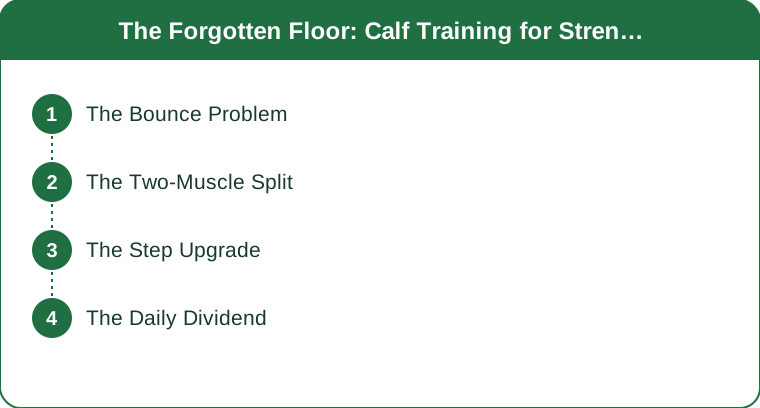
Why Don’t Calf Raises Work for Most People?
Because they’re being bounced, and a bounced calf raise trains the tendon rather than the muscle.
Here’s the mechanism. Your Achilles is a remarkably efficient elastic spring — it stores energy on the way down and returns it on the way up, which is exactly what it evolved to do for walking and running. Fast, bouncy raises let that spring handle the whole job. The movement looks like work, the reps go up, and the muscle essentially sleeps through the set.
The fix is a tempo change and nothing else:
- One count up. Drive to full contraction, all the way onto the toes.
- A one-second squeeze at the top.
- Three counts down. Slow, controlled, no drop.
- A full pause in a deep stretch at the bottom — this is the part that kills the elastic rebound, and it’s the part people skip.
Try it once on your next set. The burn relocates immediately from “vaguely in the ankle” to unmistakably in the muscle belly, and that relocation is the entire point.
What’s the Difference Between Standing and Seated Calf Raises?
They train two different muscles, which is why a program with only one of them is half a program.
Standing raises train the gastrocnemius — the visible, diamond-shaped muscle that gives the calf its shape. It crosses the knee joint, which means it only works properly with the leg straight. Fast-twitch heavy, so it wants moderate reps: 3 sets of 12, slow tempo.
Seated or bent-knee raises isolate the soleus — the deep workhorse sitting underneath. Bending the knee takes the gastrocnemius out of the equation and leaves the soleus doing everything. It’s endurance-fiber dominant and wants higher reps: 3 sets of 20.
The soleus is the one nobody trains and the one that matters most for daily function. It’s doing the majority of the work when you walk, stand, and run at easy pace, and it’s a bigger contributor to ankle stability than the visible muscle above it.
A complete calf program runs both. Total time: about five minutes.

How Should You Progress Calf Training?
Range first, then load. Most people do the reverse and wonder why nothing moves.
Use a step edge. Heels hanging off the back, dropping below the level of your toes at the bottom. This roughly doubles the working range compared to flat-floor raises, and the bottom stretch is where the growth signal actually lives — loaded stretch at long muscle lengths is one of the more consistent findings in hypertrophy research.
The progression ladder, which fits entirely on a staircase:
- Two-leg bodyweight, slow tempo, full range.
- Single-leg bodyweight. This roughly doubles the load with no equipment, and it’s where most people should live for a while.
- Single-leg loaded. Hold a dumbbell, or wear a backpack with books in it. A loaded backpack is a genuinely good calf machine.
- Add sets, then slow the tempo further (four or five counts down) before adding more weight.
Hold the stair rail for balance — it isn’t cheating, it just lets the calf work instead of your whole body fighting to stay upright.
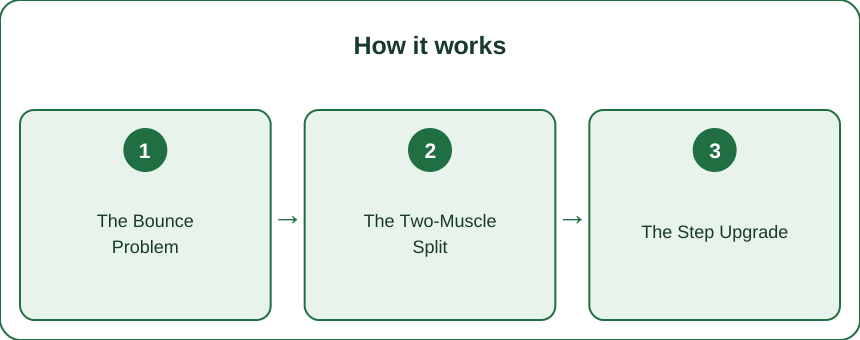
What Does Calf Training Actually Do for You?
More than the aesthetic case, which is the part usually oversold anyway.
- Running spring. The calf-Achilles complex is a major contributor to propulsion. Stronger calves mean more return per stride.
- Hiking descents. Downhill walking is heavily eccentric calf work, and it’s the specific thing that turns your legs to jelly on the way back down a mountain.
- Stairs stop being an event. Especially over 50, calf strength is one of the better predictors of comfortable stair navigation.
- Ankle stability — the sprain insurance. Stronger lower legs control landings better, which matters on trails, courts, and uneven pavement.
- The circulation pump. The soleus is sometimes called the “second heart” because its contractions genuinely assist venous return from the lower leg. That’s not a metaphor; it’s part of why sitting all day makes your legs feel heavy.
Twice weekly, five minutes. The floor of the leg deserves the tenancy.
One honest caveat on shape: if you have a high Achilles insertion, you can build a considerably stronger calf without dramatically changing how it looks. The strength and function benefits arrive regardless, and they’re the better reason to train anyway. Persistent calf pain, or pain that shows up at rest, is worth having looked at rather than trained through.
Myth vs Fact: Calf Training
Myth: Calves are genetic and can’t be changed. Fact: Shape is largely genetic — insertion point and muscle belly length are fixed. Strength, size within that frame, and function are all very trainable. Most “bad genetics” verdicts are handed down after years of bounced partial reps.
Myth: Walking and running are enough calf training. Fact: They build endurance in a narrow range and at loads your calves are already adapted to. Neither provides the loaded stretch that drives adaptation, which is why runners still get calf strains.
Myth: High reps are the only thing calves respond to. Fact: The soleus does prefer higher reps, but the gastrocnemius responds well to moderate reps with real load. Training only one way trains only half the calf.
Myth: You need a calf raise machine. Fact: A stair edge and a backpack cover the entire progression from beginner to genuinely strong. Single-leg raises alone double the load with no equipment at all.
Mini FAQ
How often should you train calves?
Two to three times a week. They recover fast — you use them all day, so they’re adapted to frequent low-level work — but they still need enough intensity to justify the session. Two focused five-minute sessions beat daily half-hearted ones.
Can you grow calves if you have bad genetics?
You can make them meaningfully stronger and somewhat larger. Insertion point and muscle belly length are fixed, and they set the ceiling on how a calf looks. Most people who believe they have bad calf genetics have actually just been bouncing through partial-range reps for a decade — worth ruling that out before accepting the verdict.
Do calf raises help with running?
Yes, in two ways: stronger calves improve propulsive spring, and they’re protective against Achilles tendinopathy and calf strains, which are among the most common running injuries. Slow eccentric work in particular is the standard rehab protocol for Achilles issues, which tells you something about its value as prevention.
TL;DR:
- Bouncy reps let the Achilles tendon do the work — one count up, three counts down, full pause at the bottom.
- Train both heads: standing raises (3×12) for the gastrocnemius, seated or bent-knee (3×20) for the soleus.
- Use a step edge so heels drop below toes; the bottom stretch is where the growth signal is.
- Progress two-leg → single-leg → loaded, and add tempo before adding weight.
- Payoff is running spring, hiking descents, stair ease, ankle stability, and genuine circulatory benefit.
Slow negatives, both muscles, step-edge range, twice a week. Calves were never unresponsive — they were being bounced instead of trained.
Keep Reading
This article is for general informational and styling purposes only. Fit, sizing, and product availability may vary.