The Hamstring Handbook: Training the Muscles Everyone Forgets Until They Complain
The hamstrings are the leg’s back office — invisible in the mirror, doing half the work, and ignored until they file a complaint mid-sprint. The hamstring handbook: why they’re neglected, the exercises that actually reach them and the injury-proofing program.

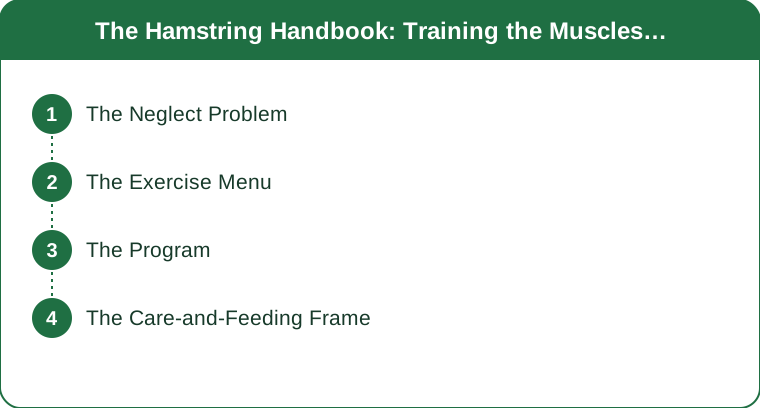
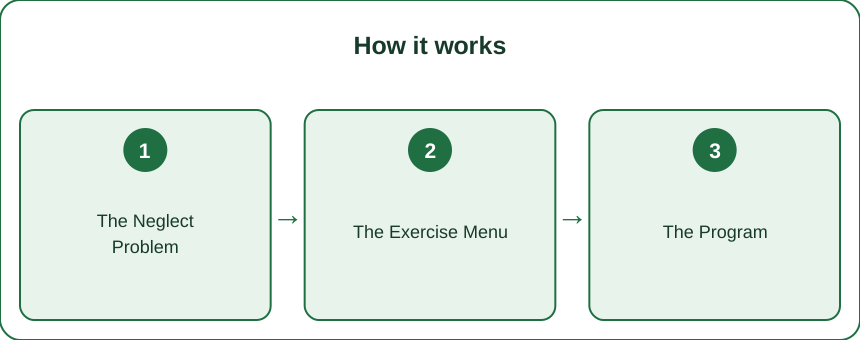
The Neglect Problem
Why hamstrings fall behind: the mirror bias (the training attention that follows visibility — the quads-and-glutes programs that treat the hamstring as scenery; the front-back imbalance that builds silently), the quad-dominance pattern (the squat-heavy programs loading the front — the knee-dominant training culture; the balance audit from the lower-body chapters), the sitting shortener (the desk hours that keep hamstrings shortened and sleepy — the tight-AND-weak combination that stretching alone can’t fix; the flexibility complaints that are really strength complaints), and the consequence list (the hamstring strain being sport’s classic injury, the knee stability that suffers, the posture chain that sags — the back office whose strike stops the company).
The Exercise Menu
Reaching the back of the leg: the hinge family (the Romanian deadlift as the crown — the hips-back pattern loading the stretch; the single-leg RDL adding balance per the unilateral doctrine; the good-morning and cable pull-through variants), the curl family (the knee-flexion work the hinge misses — the lying-and-seated curls, the stability-ball leg curl for home, the slider curls that humble everyone; the both-functions training the muscle’s both jobs), the Nordic-adjacent tier (the eccentric emphasis — the assisted Nordic lowers and the slow negatives; the injury-prevention evidence crowning eccentric hamstring work; the sore-tomorrow honesty), the bridge-and-hip-thrust note (the glute movements’ hamstring assistance — the bent-leg-versus-straight-leg loading), and the form keys (the hinge felt as a hamstring STRETCH under load — the back flat per the hinge doctrine; the range where tension lives, not the range that impresses).

The Program
The weekly dose: the frequency floor (twice weekly touching hamstrings — one hinge day, one curl-emphasis day; the pattern from the balanced-week doctrine), the volume-and-load rules (the moderate-rep controlled work — the 8-12 tier for curls, the 6-10 for hinges; the slow eccentrics counted honestly), the imbalance fix protocol (the quad-dominant history spending a block at 2-to-1 hamstring emphasis — the catch-up phase; the RDL taught before it’s loaded), the runner’s-and-lifter’s tracks (the runner adding eccentric work and hill sprints — the sprint-strain insurance; the lifter auditing the squat-to-hinge ratio), and the progress markers (the RDL load climbing, the slider curl reps arriving, the toe-touch improving WITHOUT stretching — the strength that masquerades as flexibility).
The Care-and-Feeding Frame
Keeping them happy: the warm-up specificity (the leg swings and bodyweight hinges before loading — the cold-hamstring pull being the classic; the sprint-day warm-up treated seriously per the warm-up doctrine), the desk-day counters (the standing breaks and walking from the sitting chapters — the shortened-position hours offset), the strain-response protocol (the sudden sharp mid-exercise pain stopping the session — the strain graded and rested per the comeback doctrine; the twinge-versus-tear honesty; the return through the eccentric ladder), the stretching truce (the flexibility work AFTER strength — the loaded lengthening doing both jobs; the static stretches as pleasant garnish, not the fix), and the payoff close (the trained hamstrings as invisible infrastructure — the sprint that holds, the knee that tracks, the deadlift that climbs; the back office, finally funded). Hinge twice weekly, curl what the hinge misses, go slow on the way down: the forgotten half, remembered.
Hamstrings are tight because they’re weak — RDLs and slider curls twice weekly fix what stretching can’t. Eccentric work is the strain insurance; runners and squatters need it most.
Keep Reading
This article is for general informational and styling purposes only. Fit, sizing, and product availability may vary.