How Long Should You Actually Rest Between Sets on Leg Day?
Quick Answer: For heavy compound lower body work - squats, deadlifts, hip thrusts, split squats - rest 3 to 5 minutes between sets. For accessory and isolation work, 60 to 90 seconds is fine. Legs are the largest muscle mass in the body and produce the greatest systemic fatigue, so they need more recovery than upper body work, not the same amount.
The 60-second default came from magazines, not from research.

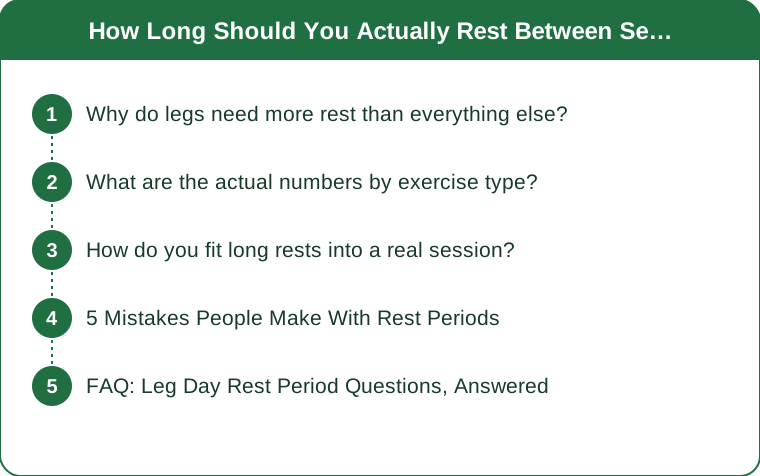
Why do legs need more rest than everything else?
Because of the sheer amount of muscle involved and what that does systemically.
A heavy set of squats recruits the quads, hamstrings, glutes, adductors, calves, spinal erectors, and the entire core. That is the largest single recruitment of muscle mass available in a gym, and the recovery demand scales with it. A set of bicep curls uses a small muscle and taxes almost nothing else; a set of five heavy squats leaves your whole system depleted.
Two systems need to recover, and they run on different clocks:
The phosphocreatine system, which fuels efforts under about ten seconds, is roughly 70 percent restored after two minutes and closer to 95 percent after three to five. Cut rest to sixty seconds and you begin your next set with well under half your available immediate energy.
The central nervous system. Heavy compound lifting produces fatigue that is not local to the muscle - it affects your ability to generate force everywhere, and it recovers more slowly than the muscle does. This is why the third set of squats can feel harder than the second even when your legs feel recovered.
The practical evidence is fairly clear. Research comparing one-minute and three-minute rest periods on compound lifts consistently finds better strength gains, and often better muscle growth, with longer rest - largely because longer rest lets you complete meaningfully more total volume at a given load.
The short-rest habit persists because it feels productive. Being out of breath feels like work. But being out of breath is a cardiovascular state, not a leg training stimulus, and if your squats are limited by your lungs rather than your legs, you are not training your legs.
What are the actual numbers by exercise type?
Rest scales with how much muscle the movement uses and how heavy it is relative to your maximum.
Heavy compounds, low reps (1 to 5): 3 to 5 minutes. Back squat, front squat, deadlift, heavy hip thrust. Anything above roughly 85 percent of your one-rep max. Five minutes is not excessive here.
Moderate compounds (6 to 12 reps): 2 to 3 minutes. Squats, Romanian deadlifts, leg press, walking lunges in a hypertrophy range.
Single-leg work (8 to 15 reps): 90 seconds to 2 minutes between sides, meaning each leg gets three to four minutes of actual recovery. Bulgarian split squats, step-ups, single-leg RDLs. These feel like accessory work and tax the system like compounds - the balance demand alone is significant.
Isolation work (10 to 20 reps): 60 to 90 seconds. Leg extensions, leg curls, calf raises, adductor and abductor machines. Small muscle, local fatigue, quick recovery.
Metabolic finishers: 30 to 60 seconds, deliberately incomplete recovery, because fatigue is the point of that block.
How to know it is right: you should be able to complete your next set with the same load and the same technique, within one repetition of the previous one. If set three is four reps below set one, your rest is too short, not your programme too hard. If you could have started a minute ago and feel completely fresh, you can shorten it.
A workable shortcut when you are not timing: rest until your breathing has returned to normal conversation, then add another 45 seconds. Most people restart at the moment breathing normalises, which is early.

How do you fit long rests into a real session?
This is the actual objection, and there are three good answers.
1. Do fewer exercises. The most common leg day error is eight exercises with rushed rest. Three or four exercises done properly beats eight done depleted. A session of squats, Romanian deadlifts, split squats, and calf raises with full rest is a complete leg day, and it will produce more than a circuit of eight.
2. Superset non-competing movements. Pair a heavy lower body lift with something that does not use the same muscles or tax the system - a squat with a face pull, a deadlift with a band pull-apart, a leg press with an ab exercise. You keep the full recovery for the leg movement while the session stays dense. The rule is that the paired exercise must be genuinely undemanding.
3. Accept a longer session or cut volume. A serious lower body session with proper rest runs 60 to 75 minutes. If you only have 40, do fewer sets with full rest rather than the same sets with half rest. Volume with quality beats volume without it.
What to do during the rest, since three minutes feels long:
- Walk. Light movement clears metabolites faster than sitting still.
- Breathe deliberately - slow nasal breathing lowers heart rate faster than scrolling does.
- Set up the next set - adjust weights, position, and cues.
- Do not scroll. Everyone does. It reliably turns three minutes into six and it costs you the session’s end.
Practical note: if you are training in a busy gym and worried about holding equipment, the non-competing superset solves that too, and most people are far more relaxed about shared equipment than the anxiety suggests.
5 Mistakes People Make With Rest Periods
1. Using one rest period for the whole session. Squats and leg extensions have completely different recovery demands. A single timer setting is the fastest way to under-rest the important lifts and over-rest the trivial ones.
2. Treating short rest as a cardio strategy. If you want conditioning, do conditioning - it is more effective and it does not compromise your strength work. Rushing squats gets you a mediocre version of both.
3. Restarting the moment breathing normalises. Breathing recovers well before the phosphocreatine system does. That feeling of being ready arrives about a minute early on heavy sets.
4. Not resting long enough between sides on single-leg work. People do the left leg, then immediately the right, then rest. The second leg is being trained under fatigue every single time, which is a reliable way to build the imbalance you were trying to fix.
5. The phone. Three minutes becomes six, the session runs 90 minutes, and the last two exercises get skipped. Set an actual timer and put the phone face down between sets - it is the single most effective change most people can make to session quality.
FAQ: Leg Day Rest Period Questions, Answered
Does long rest reduce fat loss?
No. Fat loss is driven by overall energy balance across the week, not by how out of breath a single set makes you. Training hard with full rest preserves muscle better during a deficit, which is what you actually want.
Should I rest longer as I get stronger?
Yes, generally. Heavier absolute loads produce more systemic fatigue, so an advanced lifter squatting near maximum may genuinely need five minutes where a beginner needs two.
Is it bad to rest too long?
Beyond about five minutes you start losing the warmth and readiness from the previous set, and the session becomes very long. Five minutes is a sensible ceiling for almost everyone.
What about between exercises rather than between sets?
Two to three minutes is plenty, and moving to a new exercise gives you a natural transition. There is no need to add extra time on top of your normal set rest.
How does rest change if I train legs twice a week?
It does not change per set - the recovery demand within a session is the same. What changes is total weekly volume, which you would spread across the two days rather than doubling.
TL;DR:
- Heavy compounds need 3 to 5 minutes. Moderate compounds 2 to 3. Isolation 60 to 90 seconds.
- Legs recruit the largest muscle mass in the body, so they generate the most systemic fatigue and need the most recovery.
- If set three is several reps below set one, the rest is too short - not the programme too hard.
- Fit it in by doing fewer exercises or supersetting with genuinely non-competing movements.
- Rest each side properly on single-leg work, or you train the second leg fatigued every time.
Being out of breath is a lung state, not a leg stimulus. Rest properly and lift more.
Keep Reading
This article is for general informational and styling purposes only. Fit, sizing, and product availability may vary.