How Much Rest Do Legs Actually Need Between Sessions?
Quick Answer: Recovery time depends on what kind of damage you did, not on a fixed rule. Heavy compound work with eccentric loading needs 48 to 72 hours; moderate hypertrophy work needs about 48; light, machine-based or low-eccentric work can be repeated in 24. Muscle protein synthesis is elevated for roughly 24 to 48 hours after a session in trained lifters, which is the actual argument for training legs twice a week rather than once.
Most people either train legs once a week and wonder why progress is slow, or train them hard three times and never recover enough to progress.

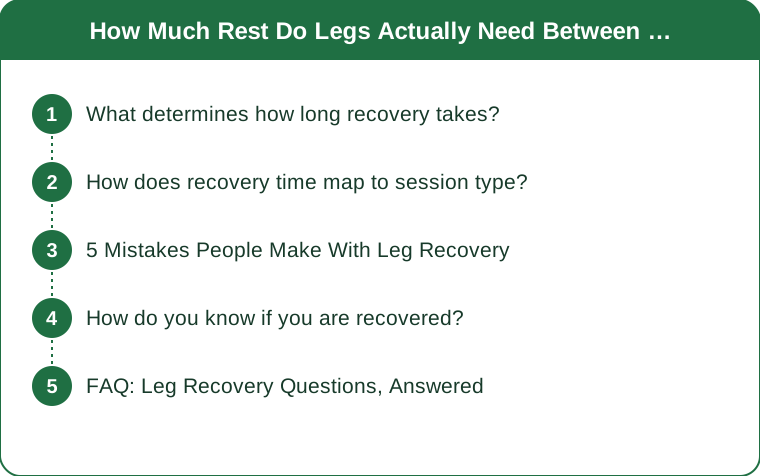
What determines how long recovery takes?
Four factors, and eccentric loading is the biggest one.
Eccentric loading causes the most muscle damage. Lowering under load - the descent of a squat, the bottom of a Romanian deadlift, the downward phase of a step-down - produces far more microtrauma than the lifting phase. Sessions heavy in slow eccentrics need the longest recovery.
Range of motion matters. Training at long muscle lengths, such as deep squats and full-range RDLs, produces greater damage and greater adaptation. A full-depth squat session needs more recovery than a partial-range one, and it is also worth more.
Novelty multiplies soreness. A new exercise produces disproportionate damage the first time. The repeated bout effect means the second session of the same movement causes markedly less, which is why week one of a new programme is misleading.
Total volume rather than intensity drives cumulative fatigue. Twenty hard sets of legs needs longer than eight, at any given intensity.
And individual factors are large. Training age, sleep, protein intake, and stress all shift the number meaningfully. Well-trained lifters with good sleep recover markedly faster than the same person sleeping six hours in a stressful month.
How does recovery time map to session type?
Three categories with three different answers.
Heavy compound sessions - 48 to 72 hours. Squats and deadlifts at 80%+ with full range and controlled descent. These are the sessions people underestimate because the soreness peaks at 24 to 48 hours, well after the session felt fine.
Moderate hypertrophy sessions - approximately 48 hours. Sets of 8 to 15 at moderate loads, mixed compound and isolation. This is the standard case that produced the 48-hour rule of thumb.
Light or low-eccentric sessions - about 24 hours. Machine work, sled pushes, cycling, high-rep pump work with limited eccentric loading. Sled work in particular is nearly all concentric and can be repeated far sooner than its difficulty suggests.
The practical structure most people should use: two leg sessions a week, 72 hours apart - one heavier and lower volume, one moderate and higher volume. This uses the muscle protein synthesis window twice rather than once and it is well supported by frequency research.
Why not once a week? Because MPS returns to baseline within roughly 48 hours in trained lifters. A single weekly session leaves about five days where nothing is being stimulated, which is why once-a-week leg day is a common cause of stalled progress despite brutal sessions.

5 Mistakes People Make With Leg Recovery
1. Using soreness as the readiness test. Soreness correlates poorly with actual recovery. You can be sore and recovered, or unsore and under-recovered. Performance is the better test - if your working weight for a given rep range has dropped, you are not recovered.
2. Training legs the day after a hard run. Endurance work creates its own recovery demand and shares the same muscle groups. Runners who add a heavy leg session the day after intervals get the worst of both, and this is the most common scheduling error in mixed training.
3. Taking complete rest instead of active recovery. Light movement - 20 to 30 minutes of easy walking or cycling - improves blood flow and typically reduces soreness compared with lying still. Rest days are not sitting-still days.
4. Under-eating protein on rest days. Repair happens on the days between sessions. Aim for 1.6 to 2.2g per kg of bodyweight daily, distributed across meals, and do not drop it on days you did not train.
5. Ignoring sleep as the primary recovery variable. Growth hormone release, protein synthesis, and central nervous system recovery are all sleep-dependent. Under 7 hours consistently means recovery takes longer than any protocol assumes, and no supplement compensates.
How do you know if you are recovered?
Four checks that take under two minutes.
Performance test. Can you hit your working weight for the same reps as last time? This is the most reliable single indicator and it is available at the start of every session.
Morning resting heart rate. A sustained elevation of more than 5 to 7 bpm above your normal suggests incomplete systemic recovery.
Warm-up feel. Legs that feel heavy through a full warm-up rather than loosening up are telling you something. Legs that loosen by set three were fine.
Motivation. Persistent reluctance to train, distinct from ordinary Monday feeling, is a genuine and under-rated fatigue signal.
What to do when you are not recovered: train, but reduce. Cut volume by roughly a third and keep intensity - this maintains the stimulus while allowing recovery to catch up, and it works better than either skipping or grinding.
And schedule a deload. Every 4 to 8 weeks, take a week at reduced volume. This is not lost time; it is when accumulated fatigue clears and the adaptation you have been building actually shows up.
Autumn note: as training moves indoors and daily step count typically drops, total leg load changes even if your programme does not. Fewer background steps means more capacity for training - many people find they tolerate slightly more leg volume in autumn than in an active summer, which is worth knowing before you assume you have plateaued.
This is general training information, not medical advice.
FAQ: Leg Recovery Questions, Answered
Can I train legs two days in a row?
If the sessions are different in character - heavy squats one day, light machine or sled work the next - it is workable. Two heavy full-range sessions back to back is not, for most people.
How many times a week should I train legs?
Two is the sweet spot for most people, spaced about 72 hours apart. Three can work with careful volume management, but it requires reducing per-session volume rather than adding a third hard day.
Does soreness mean I need more rest?
Not necessarily. Soreness is a poor proxy for recovery status. Use performance on your working sets as the test instead.
Should I stretch to recover faster?
Static stretching does not meaningfully reduce soreness or speed recovery in the research. Light movement, adequate protein, and sleep do far more.
How long does it take to recover from a really hard leg session?
After a high-volume, high-eccentric session, 72 hours is realistic and some people need more. If you are consistently needing more than 72 hours, the session volume is probably too high for your current recovery capacity.
TL;DR:
- Recovery time depends on eccentric loading, range of motion, novelty, and volume - not on a fixed 48-hour rule.
- Heavy full-range compounds: 48 to 72 hours. Moderate hypertrophy: about 48. Light or low-eccentric work: 24.
- Train legs twice a week, 72 hours apart - muscle protein synthesis returns to baseline within about 48 hours, so once-weekly leaves days of nothing happening.
- Test performance, not soreness; when under-recovered cut volume by a third and keep intensity; deload every 4 to 8 weeks.
The practical takeaway is that the question is backwards. Rather than asking how long to rest after a session, decide how often you want to train legs and then build sessions that fit that frequency - which for most people means two moderate days rather than one devastating one.
Keep Reading
This article is for general informational and styling purposes only. Fit, sizing, and product availability may vary.