The Step-Up: The Most Underrated Leg Exercise in the Building
Quick Answer: Step-ups build single-leg strength that squats can’t, because a two-legged squat lets your strong side quietly cover for your weak one. The technique that makes or breaks it: the top leg does everything — no push-off from the bottom foot, and a three-count controlled descent. Start at a knee-height box with bodyweight, 3 sets of 8–10 per leg, twice a week.
The step-up looks too simple to respect. It is, literally, stairs — formalized, indoors, with a box.
Which is exactly why it’s sitting unused in the corner of every gym while people queue for the leg press.
Here’s the case for it, and the one technique detail that separates a genuinely hard exercise from theater.

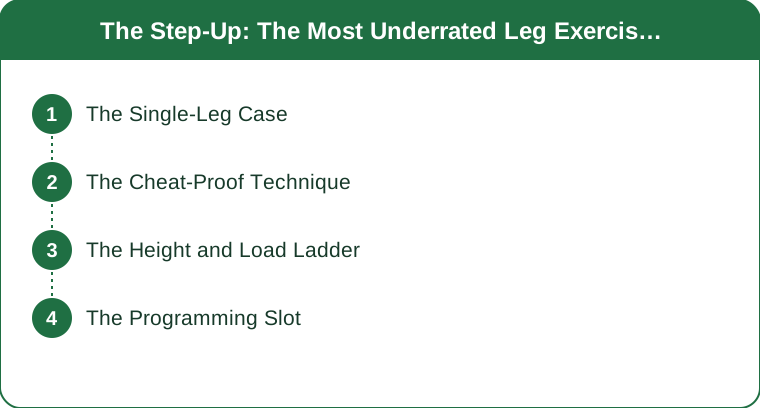
Why Are Single-Leg Exercises So Important?
Because almost nothing you do in real life is two-legged.
Every stair, every stride, every hill, every getting-up-off-the-floor loads one leg at a time. Walking is a series of controlled single-leg balances. Hiking is that, with luggage.
The two-legged squat is a superb exercise and it has one blind spot: it lets the strong side subsidize the weak one, invisibly. You can squat well with a 10–15% side-to-side difference and never know, because the bar stays level and the weight keeps going up.
Step-ups audit each leg separately. There’s nowhere to hide. The side that wobbles is the honest one, and it’s the one that was going to give you trouble on a trail or in a sport eventually.
They’re also easier on the lower back than heavy bilateral work, which makes them one of the few leg exercises that scales up without loading the spine.
What’s the Correct Step-Up Technique?
Four points, and the second one is where 90% of people go wrong.
- Whole foot on the box. Heel included. A heel hanging off shifts the work to the calf and makes the drive unstable.
- The top leg does everything. No push-off from the bottom foot. This is the classic smuggle, and it’s usually unconscious. The fix: keep the bottom toe hovering just above the floor between reps, or touch down heel-only. If you can’t do a rep without the push-off, the box is too high.
- Three-count descent. Lower back down slowly — count “one, two, three.” The way down builds roughly half the strength available in this exercise, and dropping off the box throws all of it away.
- Stand fully tall at the top. Hips locked out, torso upright, no forward lean. If you’re leaning, drop the height.
Ten strict reps beat thirty bounced ones. This is not a cardio movement; treat it like a squat that happens to involve a box.

How High Should the Box Be, and When Do You Add Weight?
Progress height first, then load. Never both in the same week.
Height ladder:
- Start low — around 30 cm, knee well below hip at the top of the step.
- Earn mid — a standard bench, roughly 40–45 cm, with the thigh at about parallel.
- Above parallel is a specialty variation, not a goal. It rewards hip flexibility more than leg strength and tempts the push-off back in.
Load ladder, once strict reps at your chosen height are easy:
- Dumbbells at your sides — simplest, and grip becomes the limiter eventually.
- A loaded backpack — great at home, keeps hands free for balance.
- Goblet hold at the chest — hardest on the core, best for keeping the torso upright.
A knee-height box with bodyweight and a strict three-count tempo is already an honest workout. Height inflation with a sloppy push-off is theater — it looks more impressive and does less.
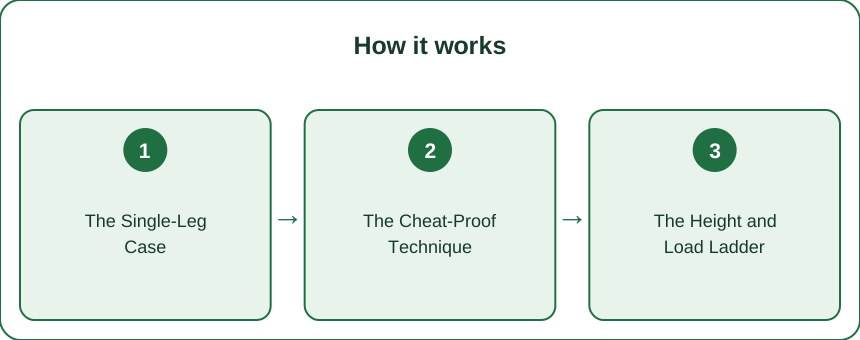
5 Mistakes Everyone Makes on Step-Ups
- Pushing off the bottom foot. The one that turns a hard exercise into a warm-up. Hover the toe.
- Dropping off the box. You’re skipping the eccentric — the half that builds the most strength and the most knee resilience.
- Going too high too soon. A box above knee height with poor control loads the knee at a deep angle with no stability. Earn it.
- Doing the weak leg second, always. Start with the weaker side and match the strong side to whatever the weak one managed. Otherwise the gap never closes.
- Rushing for reps. Step-ups get treated as conditioning because they look easy. Slow them down and they become one of the hardest 8 reps in the building.
How Should You Program Step-Ups?
3 sets of 8–10 per leg, twice a week.
Place them after squats as an accessory, or make them the main event on a day when equipment or time is short — a box and a backpack is a complete leg session if the tempo is honest.
Rest 60–90 seconds between sets. Alternate legs within a set if you prefer; just don’t let the rest for one leg become the reason the other leg’s set is easy.
Give it six weeks and the receipts arrive in real life rather than in the mirror: stairs feel shorter, hills feel springier, and the wobbly leg quietly stops being the wobbly leg.
Frequently Asked Questions
Are step-ups better than lunges?
They’re complements, not competitors. Step-ups emphasize the concentric drive up and are gentler on the front knee; lunges load the stretched position harder and challenge balance differently. If you’re picking one for real-world carryover to stairs and hills, step-ups. Most good programs use both.
What muscles do step-ups work?
Primarily the quadriceps and glutes of the working leg, with the hamstrings and adductors assisting and the calves and core stabilizing throughout. A higher box shifts more work to the glutes; a lower box biases the quads. The stabilizing demand on the hip is a large part of why they carry over so well.
Do step-ups build muscle or just endurance?
Both, depending on load. Bodyweight step-ups for 15+ reps train endurance; loaded step-ups in the 6–10 rep range with a controlled descent build size and strength like any other resistance exercise. If you have existing knee pain, check with a physiotherapist first — step-ups are often used in knee rehab, but the right height and load matter, and guessing at them isn’t the move.
TL;DR:
- Life is single-leg; squats let the strong side hide the weak one, step-ups don’t.
- Whole foot on the box, top leg does everything, three-count descent, stand fully tall.
- Hover the bottom toe to kill the push-off — the single biggest cheat.
- Height ladder first (30 cm → bench), then load (dumbbells → backpack → goblet).
- 3 × 8–10 per leg, twice weekly, weaker leg first and match the strong side to it.
- Six weeks of strict reps and stairs, hills, and side-to-side balance all change.
Keep Reading
This article is for general informational and styling purposes only. Fit, sizing, and product availability may vary.