The Single-Leg Exercise Almost Everyone Skips (and Shouldn't)
Quick Answer: The single-leg Romanian deadlift (single-leg RDL) is the most commonly skipped leg exercise — it trains hamstring strength, hip hinge mechanics, and balance simultaneously, which most standard leg-day exercises don’t combine.
Most leg days are built around squats, lunges, and step-ups — all great, but all missing one specific pattern: a loaded hip hinge on one leg. That gap is exactly what the single-leg RDL fills.

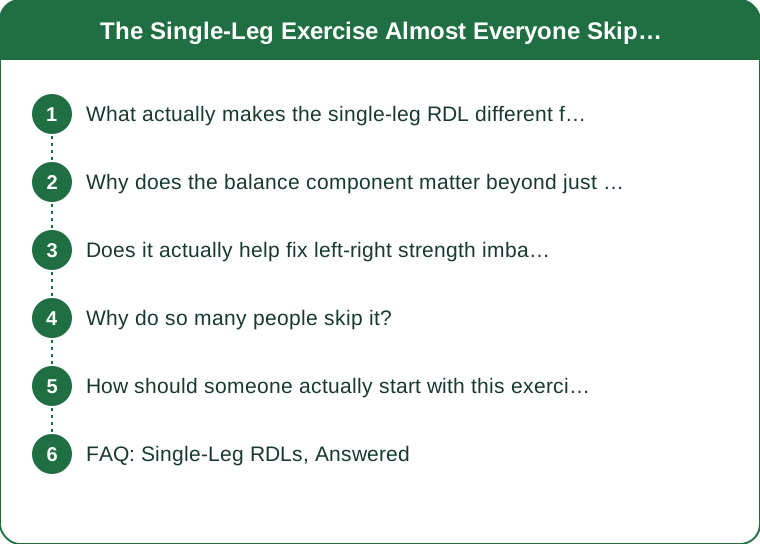
What actually makes the single-leg RDL different from other leg exercises?
Most leg exercises are either bilateral (both feet down, like squats) or single-leg but knee-dominant (like lunges and step-ups). The single-leg RDL is one of the few common exercises that’s both single-leg and hip-dominant, directly targeting hamstrings and glutes through a hinge pattern most leg days never touch unilaterally.
Why does the balance component matter beyond just ‘core work’?
Standing on one leg while hinging forward challenges the small stabilizer muscles around the ankle, knee, and hip simultaneously — this is directly relevant to real-world stability (stepping off a curb unevenly, catching yourself on uneven ground) in a way bilateral exercises don’t replicate.
Does it actually help fix left-right strength imbalances?
Yes, more directly than most bilateral exercises — because each leg works independently with no ability for a stronger side to compensate for a weaker one, imbalances that hide during squats often become obvious (and correctable) with single-leg RDLs.

Why do so many people skip it?
It’s genuinely harder to learn than it looks — balance takes longer to feel stable than strength does, which makes early attempts feel awkward and discouraging compared to exercises that feel competent from set one.
How should someone actually start with this exercise?
Begin with bodyweight only, holding onto something stable for balance if needed, focusing purely on the hinge pattern and balance before adding any load. Most people need several sessions of bodyweight practice before the pattern feels stable enough to add a dumbbell.
FAQ: Single-Leg RDLs, Answered
How much weight should I use once I add load?
Start lighter than you’d expect relative to your bilateral RDL — the balance demand alone adds significant difficulty even with less weight.
Is it normal to be much better on one side than the other?
Yes, initially — this is often exactly the imbalance the exercise is designed to reveal and correct over time with consistent practice on both sides.
What if I genuinely can’t balance at all on one leg?
Start with assisted versions (light fingertip support on a wall or chair) and basic single-leg balance holds before adding the hinge — balance itself is trainable and improves with consistent practice.
TL;DR:
- The single-leg RDL combines a hip hinge, hamstring loading, and balance in one movement most leg days skip
- It exposes and corrects left-right imbalances more directly than bilateral exercises
- Balance takes longer to feel competent at than strength, which is why people avoid it early on
- Start bodyweight, use support if needed, and add load gradually once the pattern feels stable
It’s one of the most transferable single-leg exercises for real-world stability, not just gym strength.
Keep Reading
This article is for general informational and styling purposes only. Fit, sizing, and product availability may vary.