Why the Humble Step-Up Trains More Than Squats and Lunges Combined in Some Specific Ways
Quick Answer: The step-up asks one leg to lift your entire body weight vertically with zero help from the other — something neither a squat nor a lunge does. That makes it a genuinely different exercise, not a beginner’s lunge. Keep the step high enough to be challenging, keep the trailing leg passive, and add load once bodyweight gets easy.
The step-up lives in the warm-up section of most programs. Twelve reps on a low box, no weight, done while chatting.
That’s a demotion the exercise didn’t earn — and it’s why most people never find out what it actually does.

What Makes the Step-Up Different From a Squat or Lunge?
One thing, and it’s structural: the working leg generates 100% of the lifting force with no assistance from the other leg at any point.
Compare that honestly.
- A squat loads both legs simultaneously. Even at high loads, the work is shared, and a stronger side can quietly compensate for a weaker one.
- A lunge is closer to unilateral, but the rear leg maintains ground contact and contributes real support and stability throughout. It’s assisted single-leg work.
- A step-up gives the working leg nothing. The other foot leaves the ground and stays useless. There’s no sharing and no compensating.
There’s a second distinguishing feature: the vertical component. A step-up moves your entire body weight upward against gravity through a single leg. A lunge is largely a descend-and-return in place; a squat moves you down and back up on two legs. Lifting your whole mass vertically on one leg is a different demand from either.
So it isn’t a simpler lunge. It’s a different exercise with a specific job.
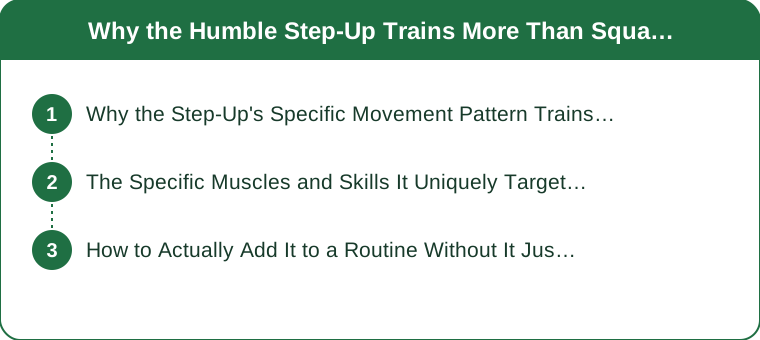
What Does It Actually Train?
More complete unilateral glute and quad strength. Because nothing assists, each leg has to be independently capable. This exposes and then corrects side-to-side imbalances that a squat can hide for years — many people discover a genuine strength difference the first time they do proper step-ups.
Single-leg balance and stability under load. Standing on one leg while producing maximum force is a stability demand well beyond a lunge with a grounded rear foot. Ankle, knee, and hip stabilizers all work considerably harder here.
A movement pattern you actually use. Stairs, curbs, hills, getting up off the floor — all single-leg vertical propulsion. The step-up is one of the closest gym movements to something you genuinely do daily, which is part of why it holds up so well as people get older.
Hip control through the frontal plane. Watch someone’s working-side hip during a step-up. If it drops or the knee caves inward, you’ve found a glute medius weakness that squats rarely reveal.

5 Mistakes Everyone Makes on Step-Ups
- Using a step that’s too low. A low box turns the movement into a shallow lunge and removes the whole distinguishing benefit. This is the biggest one by far.
- Pushing off with the trailing leg. The most common cheat, and it silently converts the exercise back into assisted work.
- Bouncing off the floor between reps. Momentum does the job the leg was supposed to do.
- Dropping down uncontrolled. The lowering phase is real training. Free eccentric work, wasted.
- Never adding weight. The third mistake surprises people, but this is the one that keeps step-ups stuck in warm-up purgatory — treating a legitimate strength exercise as permanently bodyweight-only.
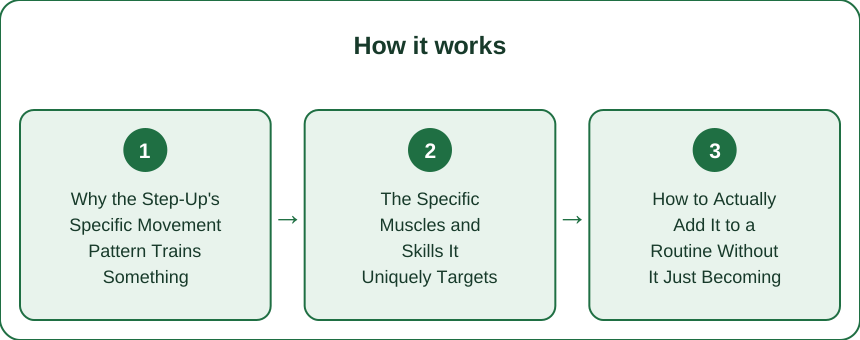
How Do You Program It Properly?
Choose a step height that’s genuinely challenging. A common starting point is a height that puts your knee at roughly 90 degrees when your foot is on the box — often mid-shin to knee height for most people. If you can do 15 reps per side without much difficulty, it’s too low. Height is the first progression variable, before load.
Keep the trailing leg deliberately passive. Let it hang. Some coaches cue tapping the toe or holding it slightly off the ground entirely, so pushing off becomes impossible. Whatever the cue, the intent is the same: the working leg does all of it.
Control the descent. Lower yourself over about 2 seconds rather than dropping. The eccentric phase is a substantial part of the training effect and it’s free.
Then load it. Dumbbells at your sides are the simplest option. Start with something you can handle for 8 clean reps per side, run 3 sets, and progress the weight over weeks the way you’d progress a squat.
A workable slot: 3 sets of 8–10 per side, twice a week, placed after your main compound lift rather than as a warm-up afterthought.
Practical note: step-ups involve deep knee flexion, hip drive, and a leg swinging up onto a box, so anything that binds or rolls at the waist gets annoying fast. Squat-proof high waist leggings that hold their position let you focus on keeping the hip level rather than on your waistband.
When to see a professional: knee pain during step-ups, or a hip that drops noticeably on one side despite cueing, is worth a physical therapist’s assessment before you add load. This is general information, not medical advice.
FAQ
How high should my step be?
High enough that your knee is around 90 degrees with your foot on it — usually mid-shin to knee height. If 15 reps per side feels easy, go higher before going heavier.
Are step-ups better than lunges?
They’re different, not better. Step-ups remove all assistance and add a vertical lifting component; lunges have their own value for eccentric control and hip mobility. Most good programs include both.
Can step-ups replace squats?
They can be the main lower-body lift in a program without a barbell, and they’re excellent for that. If you have access to heavy bilateral loading, squats still offer something step-ups don’t.
TL;DR
- The working leg does 100% of the work with zero assistance — unlike a squat (both legs) or a lunge (rear-leg support).
- It adds a vertical lifting component neither of the others fully replicates.
- It trains unilateral glute and quad strength, single-leg stability, and frontal-plane hip control.
- Keep the step high, the trailing leg passive, and the descent controlled — then add real load.
- See a PT for knee pain or a persistently dropping hip.
Keep Reading
This article is for general informational and styling purposes only. Fit, sizing, and product availability may vary.