Why Single-Leg Exercises Might Be Doing More for You Than Squats
Quick Answer: Single-leg (unilateral) exercises like split squats and single-leg deadlifts specifically expose and correct left-right strength imbalances that bilateral lifts like the barbell squat can mask, since a stronger leg can compensate for a weaker one during a two-legged lift without anyone noticing — making unilateral training a valuable addition, not a replacement, for a well-rounded leg program.
Most people assume their squat numbers reflect balanced leg strength. Often, one leg is quietly doing more of the work.

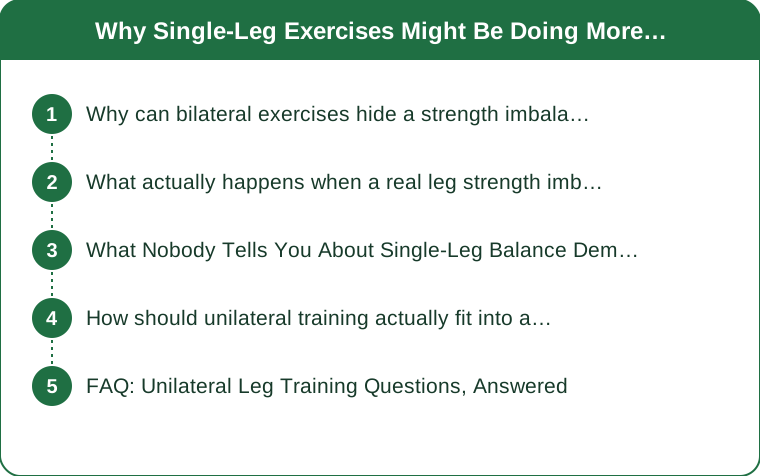
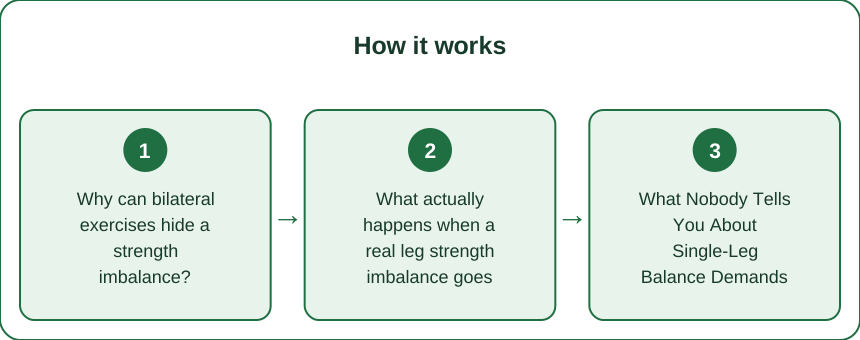
Why can bilateral exercises hide a strength imbalance?
During a barbell squat, the stronger leg can shift more of the load onto itself without the lifter necessarily feeling or noticing it — the bar simply moves, regardless of exactly how the work was distributed between the two legs.
This compensation is subtle enough that many people with a real, measurable strength difference between legs have no idea it exists until they try a single-leg version of a similar movement and immediately feel the difference.
What actually happens when a real leg strength imbalance goes unaddressed?
Persistent imbalance increases the risk of overuse injury on the dominant side (which handles disproportionate load across all bilateral training) and can contribute to compensatory movement patterns that show up during running, jumping, or cutting sports.
This is part of why unilateral training is heavily emphasized in return-to-sport and injury prevention programs specifically — it’s one of the more reliable ways to catch and correct an imbalance before it contributes to an actual injury.

What Nobody Tells You About Single-Leg Balance Demands
Here’s an underrated benefit: single-leg exercises simultaneously train balance and proprioception (joint position sense) in a way bilateral lifts simply don’t, since standing on one leg under load requires constant small stabilizing adjustments that two-leg stability doesn’t demand.
This stabilization training carries over meaningfully to real-world movement and injury resilience — activities like running, hiking on uneven terrain, or catching your balance after a stumble all rely on single-leg stability that pure bilateral training doesn’t specifically build.
How should unilateral training actually fit into a leg program?
- Bulgarian split squats and single-leg deadlifts as core unilateral movements alongside (not instead of) bilateral lifts
- Comparing rep quality and effort between sides to actually notice any imbalance rather than assuming none exists
- Starting light on single-leg work while balance and stabilizer strength develop, since the stability demand alone is a real training stimulus initially
- Programming unilateral work 1-2x per week as a complement to, not full replacement of, bilateral squats and deadlifts
FAQ: Unilateral Leg Training Questions, Answered
Should beginners start with unilateral or bilateral leg exercises?
Most beginners benefit from starting with basic bilateral movements to build foundational strength, then adding unilateral work once basic squat and hinge patterns feel comfortable.
How can you tell if you actually have a leg strength imbalance?
Trying a single-leg version of a familiar bilateral movement (like a single-leg press or split squat) at a comparable relative load often immediately reveals a noticeable side-to-side difference in either strength or stability.
Can unilateral training fully replace bilateral squats and deadlifts?
Not ideally — both offer distinct benefits (bilateral lifts allow heavier absolute loading, unilateral work addresses imbalance and stability), so a well-rounded program typically includes both.
TL;DR:
- Bilateral lifts can mask real strength imbalances between legs through unconscious compensation
- Unaddressed imbalance raises overuse injury risk and can affect sport movement patterns
- Single-leg work uniquely trains balance and proprioception bilateral lifts don’t address
- Unilateral exercises work best as a complement to, not a replacement for, bilateral training
Your squat number might be balanced-looking on the bar and still hiding an uneven split between your legs — single-leg work is how you’d actually find out.
Keep Reading
This article is for general informational and styling purposes only. Fit, sizing, and product availability may vary.