Why Your Ankles Are Limiting Your Leg Day More Than Your Legs Are
Quick Answer: Squatting to depth requires roughly 35 to 40 degrees of ankle dorsiflexion, and a large proportion of people have less. When the ankle runs out of range, the body finds it elsewhere — heels lift, the torso folds forward, or the knees drift inward. Test it with the knee-to-wall test: if you cannot reach 10cm, ankles are your limiter.
This is general information, not medical advice.

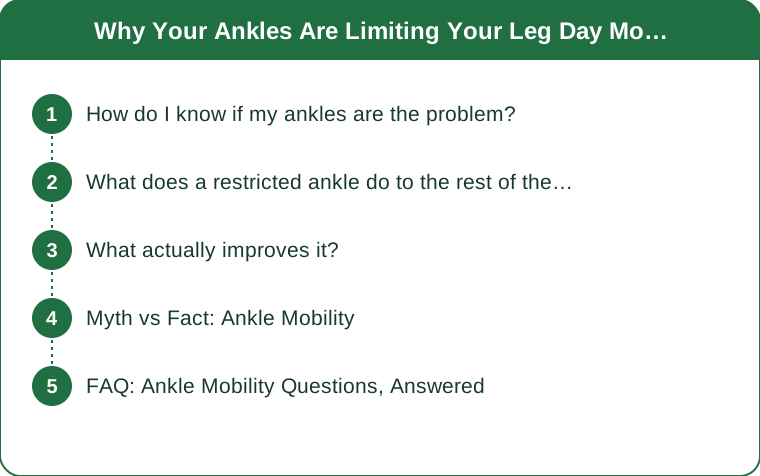
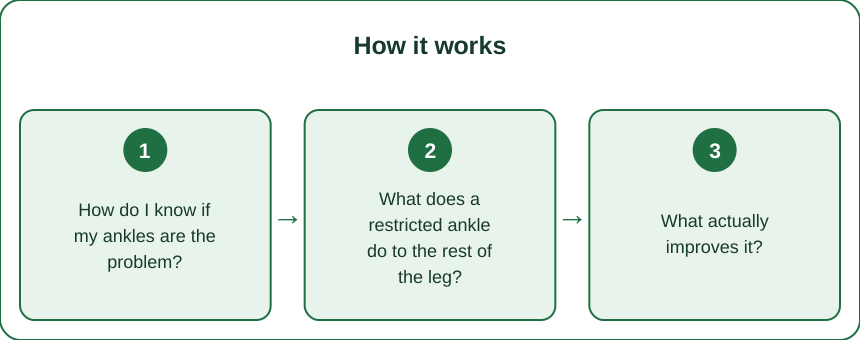
How do I know if my ankles are the problem?
Use the knee-to-wall test. Face a wall in a half-kneeling position, foot flat, and drive your knee forward over your toes to touch the wall without your heel lifting. Move the foot back until you find the maximum distance.
Ten centimetres is a common working benchmark. Less than that is generally considered restricted for squatting, and under 5cm is a significant limitation that will show up in almost every lower body movement.
Test both sides separately. Asymmetry is extremely common, particularly after any ankle sprain history, and a side-to-side difference of more than a couple of centimetres explains a lot of one-sided squat problems.
Then test the squat itself. Squat in shoes with a raised heel, or with small plates under your heels. If depth, torso angle and knee tracking all improve immediately, you have your answer.
Watch what happens at the bottom. Heels lifting, a sudden forward fold of the torso, or the feet rolling inward as you descend are all classic signs of running out of ankle range.
And check your ankle sprain history. A sprained ankle from years ago frequently leaves reduced dorsiflexion that nobody ever addressed, and it stays restricted indefinitely without deliberate work.
What does a restricted ankle do to the rest of the leg?
It forces the torso forward. With less ankle range, the only way to keep your centre of mass over your feet is to lean further forward, which shifts load from the quads toward the lower back and hips.
It reduces quad involvement. A more upright squat loads the quads more; a forward-leaning squat loads them less. People who complain their quads never feel anything in squats are often describing an ankle problem.
It pushes the knees inward. When the ankle cannot dorsiflex straight ahead, the foot rolls inward to find the range, and the knee follows. That inward drift is one of the most common findings in people with knee pain.
It limits depth, which limits glute development. Depth matters for glute involvement, so a restriction at the ankle quietly caps the effectiveness of your main lower body lift.
It affects single leg work far more. Split squats, lunges and step-ups all demand more dorsiflexion than a bilateral squat, which is why one-sided restrictions become obvious the moment you switch to unilateral training.
And it changes your calf training too, since a stiff ankle limits the stretch position where a lot of calf development happens.

What actually improves it?
Loaded stretching beats passive stretching. Weighted knee-to-wall drives, holding a dumbbell, done for three sets of ten slow reps per side, produces faster change than holding a static calf stretch.
Work the soleus specifically. The calf has two main muscles, and the soleus — worked with a bent knee — is the one that limits dorsiflexion in a squat. Bent-knee calf stretches and seated calf raises target it; straight-leg stretches largely do not.
Add a joint mobilisation. A band pulling the ankle joint backwards while you drive the knee forward addresses the joint itself rather than only the muscle, and many people get more from it than from stretching alone.
Train through the range you gain. Mobility that is not used is not kept. Follow mobility work immediately with squats, split squats or heel-elevated work in the new range.
Give it eight to twelve weeks. Ankle range responds slowly compared with hips, and people abandon it at three weeks. Consistency beats intensity here more than almost anywhere else.
And use heel elevation in the meantime. Lifting shoes or a small plate under the heels lets you train the pattern properly while the range improves, rather than practising a compromised squat for three months.
Myth vs Fact: Ankle Mobility
Myth: If your heels lift, you have tight hamstrings. Fact: Heels lifting is an ankle issue almost by definition. Hamstring tightness produces a different pattern — usually a rounded lower back rather than lifted heels.
Myth: Heel-elevated shoes are cheating. Fact: They are a tool. Olympic lifters use them deliberately because a raised heel changes the mechanics in a useful way. Using them while you work on range is sensible, not avoidance.
Myth: Foam rolling your calves fixes ankle mobility. Fact: It can produce a short-term change lasting minutes. Lasting improvement needs loaded work through range, and the roller is a warm-up rather than a solution.
Myth: Everyone should be able to squat below parallel with a narrow stance. Fact: Hip structure varies substantially between individuals, and some people will never achieve certain positions regardless of mobility work. Ankle range is trainable; hip socket shape is not.
Myth: Ankle mobility only matters for squatting. Fact: It affects walking downhill, descending stairs, running mechanics and landing from a jump. It is one of the higher-value things to fix for reasons well beyond leg day.
Myth: Stretching before lifting fixes it for the session. Fact: Static stretching immediately before lifting can slightly reduce force output. Do the mobility work as its own session or in the warm-up combined with loaded movement, not as passive holds before a heavy squat.
FAQ: Ankle Mobility Questions, Answered
How long until I see a change?
Most people notice a measurable improvement in the knee-to-wall test within four to six weeks of consistent work, with meaningful squat changes closer to eight to twelve.
Should I stop squatting until it improves?
No. Squat with a heel elevation so the pattern stays good, and work on the range separately. Stopping entirely costs you more than it gains.
Why is one ankle so much worse than the other?
Usually an old sprain. Ankle injuries frequently leave lasting restriction because rehabilitation typically stops once pain resolves, well before range is restored.
Is a bony block a real thing?
Yes — some restriction is structural rather than muscular, and it feels like a hard stop at the front of the ankle rather than a stretch at the back. That is worth having assessed rather than stretching harder.
TL;DR:
- Deep squatting needs roughly 35 to 40 degrees of dorsiflexion, and many people have less.
- Test with knee-to-wall; under 10cm is restricted, and test each side separately.
- A stiff ankle forces a forward lean, reduces quad involvement and pushes the knees inward.
- Loaded knee-to-wall drives, bent-knee soleus work and banded joint mobilisation beat passive stretching.
- Elevate the heels to train the pattern properly while the range improves; give it eight to twelve weeks.
Stop stretching your hips. Test your ankles.
Keep Reading
This article is for general informational and styling purposes only. Fit, sizing, and product availability may vary.