Why Your Legs Feel Fine the Day After Leg Day, Then Wreck You on Day Two
Quick Answer: Delayed onset muscle soreness (DOMS) typically peaks 24-72 hours after a hard leg session, not immediately, because the inflammatory and repair response that causes the soreness sensation takes time to fully develop — day two is usually the worst specifically because that’s the middle of this biological window.
Feeling great the day after leg day, then barely able to sit down on day two, isn’t your body being inconsistent — it’s exactly on schedule.

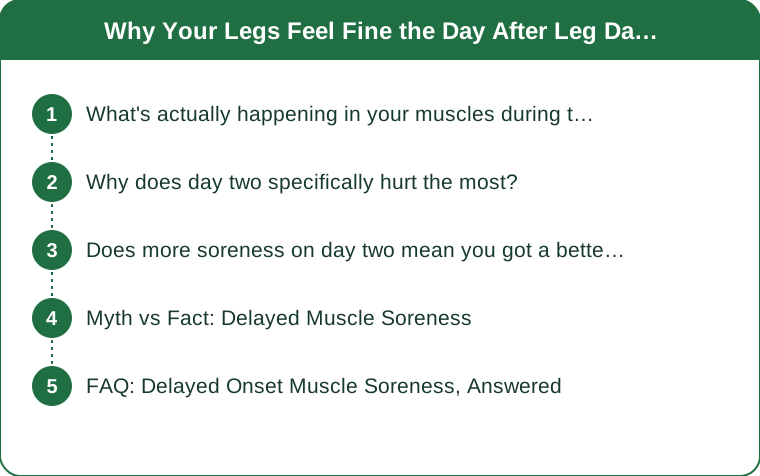
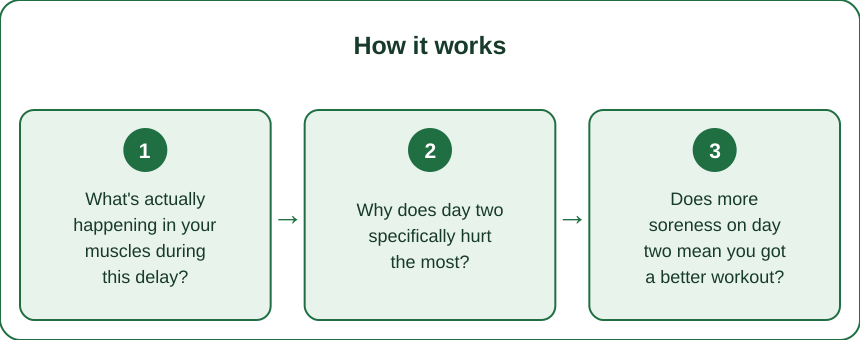
What’s actually happening in your muscles during this delay?
Hard eccentric-heavy training (squats, lunges, the lowering phase of any leg movement) creates microscopic muscle fiber damage. Your body’s inflammatory and repair response to that damage — not the initial damage itself — is what produces the soreness sensation, and that response takes time to ramp up.
Why does day two specifically hurt the most?
The inflammatory response generally peaks between 24 and 72 hours post-exercise. Day one, you’re often still in the early stage of that response; day two frequently lands right in the peak window, which is why it consistently feels worse than the day immediately following the workout.

Does more soreness on day two mean you got a better workout?
Not necessarily. Soreness intensity correlates loosely with training novelty and eccentric load, not effectiveness — a new exercise or rep range often produces more DOMS than a familiar, equally effective one. Chasing soreness as a training goal isn’t a reliable strategy.
Myth vs Fact: Delayed Muscle Soreness
Myth: No soreness means the workout didn’t work. Fact: As your body adapts to a movement pattern, soreness naturally decreases even while strength continues improving — this is called the repeated bout effect.
Myth: You should avoid all movement on the sorest day. Fact: Light movement (walking, easy cycling) generally helps circulation and can modestly ease soreness rather than worsen it.
Myth: Stretching immediately after a workout prevents DOMS. Fact: Research doesn’t strongly support post-workout stretching as an effective DOMS prevention strategy — training load management matters more.
FAQ: Delayed Onset Muscle Soreness, Answered
How long does DOMS typically last in total?
Most cases resolve within 3-5 days total, with day two or three usually marking the peak before it steadily improves.
Should I train again if I’m still sore on day three?
Light to moderate training of the same muscle group is generally fine if soreness is mild; hold off on max-effort work until soreness has substantially eased.
Is severe, sharp pain the same thing as normal DOMS?
No — DOMS is a dull, diffuse soreness. Sharp, localized, or joint-specific pain is a different signal and worth evaluating separately, not just waiting out.
TL;DR:
- DOMS peaks 24-72 hours post-workout because the repair response takes time to build
- Day two often hurts most because it lands in the middle of that response window
- More soreness doesn’t mean a more effective workout — novelty drives it more than results
- Light movement generally helps; save max-effort training until soreness substantially eases
This is general information, not medical advice — sharp or joint-specific pain is a different signal worth checking separately.
Keep Reading
This article is for general informational and styling purposes only. Fit, sizing, and product availability may vary.