Why One Leg Almost Always Feels Stronger Than the Other (And When That's a Problem)
Quick Answer: Mild leg strength asymmetry (roughly 5-10%) is extremely common and usually not a problem — it becomes worth addressing when the gap exceeds about 15%, causes visible compensation in bilateral lifts, or comes with pain on one side specifically.
You’ve probably noticed it during single-leg work: one leg is just stronger, more stable, more coordinated than the other. That’s the norm, not the exception — the real question is where the line sits between normal asymmetry and something worth actively correcting.

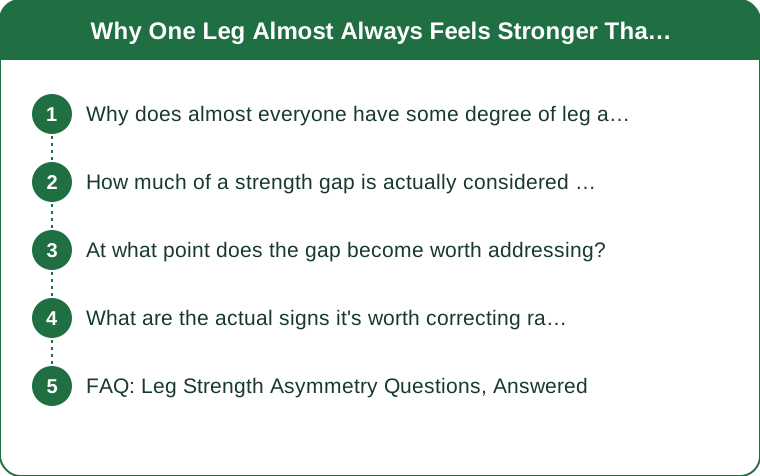
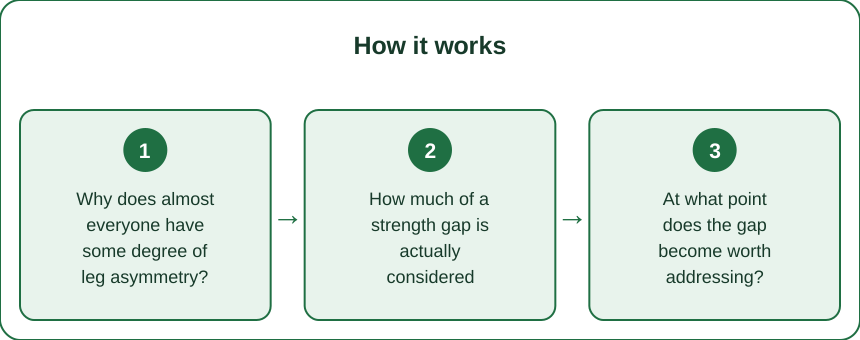
Why does almost everyone have some degree of leg asymmetry?
Limb dominance — similar to hand dominance — means most people naturally favor one side for single-leg activities (kicking, stepping off a curb, catching balance) throughout daily life, building slightly more strength and coordination on that side over years, well before any structured training even begins.
How much of a strength gap is actually considered normal?
Research on limb asymmetry generally places 5-10% difference between sides as common and not concerning on its own. This range shows up in single-leg strength and power testing across a wide range of otherwise healthy, uninjured individuals.

At what point does the gap become worth addressing?
A gap exceeding roughly 15%, especially if it’s new or worsening rather than a longstanding baseline, is generally considered worth structured attention — both because it can affect bilateral lift performance and because it may increase injury risk on the weaker side through compensation patterns.
What are the actual signs it’s worth correcting rather than just monitoring?
Visible compensation during bilateral lifts (squats or deadlifts where one side clearly does more work), pain specifically on the weaker or stronger side, or a gap that’s actively widening over time rather than staying stable are the clearer signals to add deliberate unilateral correction work, rather than just noting the asymmetry and moving on.
FAQ: Leg Strength Asymmetry Questions, Answered
Will unilateral training alone fix a strength gap over time?
Often yes for moderate gaps — deliberately programming slightly more volume or starting sets with the weaker leg tends to narrow gaps gradually over consistent months of training.
Is it worth getting a professional assessment for asymmetry?
If the gap is significant (15%+) or accompanied by pain, a physical therapist or qualified coach can rule out underlying causes beyond simple limb dominance, like a past injury history affecting one side.
Does this asymmetry pattern apply to upper body too, not just legs?
Yes, the same general principle applies to arm and shoulder strength asymmetry, though leg asymmetry gets more attention since it more directly affects bilateral lower-body lift performance and injury risk.
TL;DR:
- Mild leg strength asymmetry (5-10%) is extremely common and generally not a concern on its own
- A gap exceeding roughly 15%, especially if new or worsening, is worth structured attention
- Visible compensation in bilateral lifts and one-sided pain are clearer signals than the gap number alone
- Deliberate unilateral training, prioritizing the weaker side, tends to narrow moderate gaps over time
Keep Reading
This article is for general informational and styling purposes only. Fit, sizing, and product availability may vary.