Why One Leg Feels Noticeably Stronger During Single-Leg Work
Quick Answer: Bilateral lifts like squats let a stronger leg quietly compensate for a weaker one. Single-leg work removes that safety net, which is why imbalances that were invisible in a barbell squat suddenly feel obvious in a split squat.
Your squat numbers look totally even. Then you switch to Bulgarian split squats and one side wobbles while the other feels solid. You didn’t get weaker overnight — you just found what your squat was hiding.

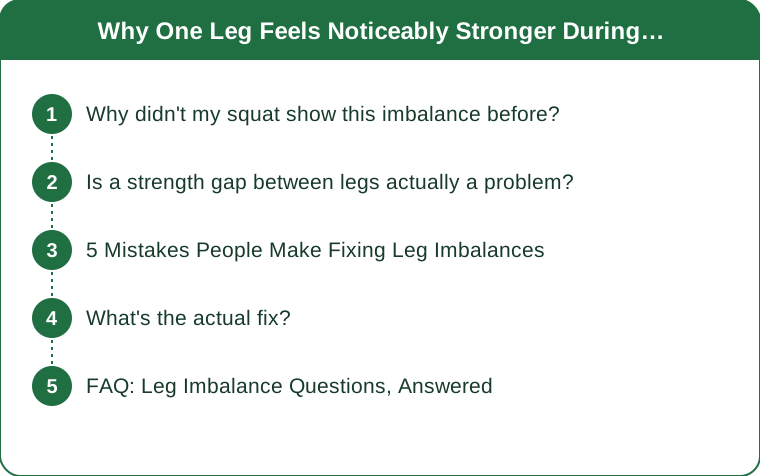
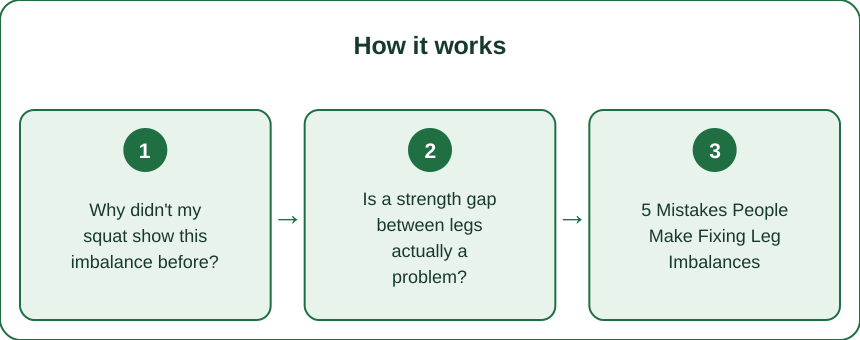
Why didn’t my squat show this imbalance before?
In a two-legged lift, force output isn’t measured per leg — it’s combined. A dominant leg can contribute 55-60% of the work without you ever noticing, because the total number still looks fine.
Unilateral exercises force each leg to produce 100% of its own output. That’s the whole reason trainers use them — not to build muscle differently, but to reveal what bilateral training conceals.
Is a strength gap between legs actually a problem?
A small gap — most research suggests up to roughly 10-15% — is normal and not worth chasing perfection over. Every body has a dominant side.
A gap that feels closer to 25-30%, or one that’s getting worse over time, is worth addressing before it becomes a compensation pattern that shows up as knee or hip discomfort on the weaker side.

5 Mistakes People Make Fixing Leg Imbalances
1. Only training the weak leg. Both sides need work — the strong leg still needs to progress, just not faster than the weak one catches up.
2. Matching reps instead of matching effort. If the weak leg hits failure at rep 8 and the strong leg at rep 14, doing 10 reps each isn’t equal work.
3. Skipping unilateral work entirely to avoid the wobble. That avoidance is exactly how the gap grows.
4. Ignoring hip and ankle mobility on the weaker side, which is often the real limiter, not muscle strength.
5. Expecting it to close in 2 weeks. Realistic timelines run 8-12 weeks of consistent unilateral training.
What’s the actual fix?
Train the weak leg first in the workout, while you’re freshest, and let the strong leg train second. Use a rep range close to failure (2 reps in reserve) on each side independently rather than a fixed number.
Add single-leg balance work (10-20 second holds) on off days — often the gap is stability-driven, not pure strength.
FAQ: Leg Imbalance Questions, Answered
How do I know if my leg imbalance needs a professional’s help?
If the wobble comes with pain, or one leg visibly gives out under light load, see a physical therapist before pushing more volume.
Will single-leg training fix imbalance on its own?
It’s the main tool, but hip mobility and ankle stability work often close the remaining gap faster than strength work alone.
How often should I do unilateral leg work?
2 times a week is enough to make steady progress without overloading the weaker side.
TL;DR:
- Bilateral lifts hide imbalance; unilateral work reveals it — that’s the point, not a setback
- A 10-15% gap is normal; 25-30%+ or worsening is worth addressing
- Train the weak leg first, match effort not reps, add balance work
- Expect 8-12 weeks for a real gap to close
The wobble isn’t new weakness — it’s information your squat couldn’t show you.
Keep Reading
This article is for general informational and styling purposes only. Fit, sizing, and product availability may vary.