Why a Single Leg-Focused Workout Won't Fix a Strength Imbalance (and What Actually Does)
Quick Answer: A genuine side-to-side leg strength imbalance typically needs several weeks of consistently prioritizing the weaker leg first in unilateral work, not just adding one single-leg exercise into an otherwise bilateral-heavy routine.
One Bulgarian split squat added to leg day feels like progress. For a real imbalance, it’s barely a start.

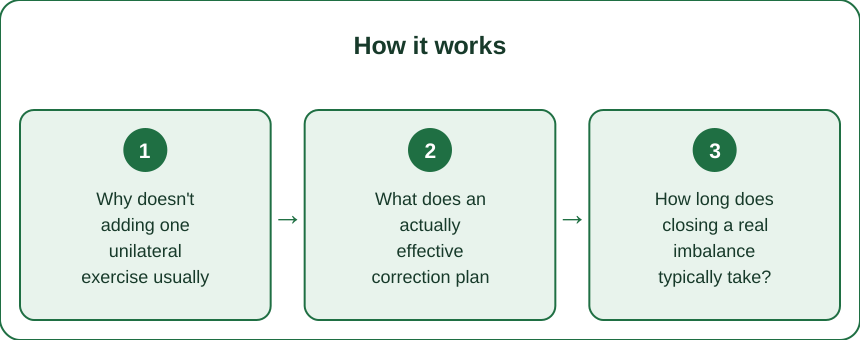
Why doesn’t adding one unilateral exercise usually fix the imbalance?
A single exercise added once or twice a week provides too little dose to meaningfully close a real strength gap, especially if the rest of the routine remains bilateral (squats, leg press) where the stronger leg can still compensate.
Bilateral exercises let the dominant leg quietly do more of the work, even when both feet are on the ground, which is part of why imbalances can persist through months of squatting without anyone noticing.
What does an actually effective correction plan look like?
Prioritizing the weaker leg first in every unilateral exercise while fresh, and matching or slightly exceeding the stronger leg’s reps, is the core mechanism that closes gaps over several weeks.
Shifting the overall program to lean more heavily on unilateral movements temporarily, rather than treating them as an add-on to a bilateral-dominant routine, gives the correction enough training volume to actually work.

How long does closing a real imbalance typically take?
Most people see meaningful improvement over 6-10 weeks of consistent, deliberate correction, though the exact timeline depends on how large the initial gap was and how consistently the weaker-side-first approach is followed.
Tracking reps or load per side over time, rather than relying on how a leg “feels,” gives a more reliable read on actual progress than subjective impressions alone.
Why Your Legs Feel Worked but Don’t Look Different
Feeling fatigued after a leg workout doesn’t confirm even loading between sides — the stronger leg can absorb more total work and still leave you sore everywhere, masking the imbalance underneath.
A less obvious factor: visual symmetry can look fine while functional strength differs, since muscle size doesn’t always track precisely with strength output, especially in smaller stabilizer muscles.
FAQ: Leg Strength Imbalance Questions, Answered
Is some imbalance between legs always normal?
Yes — a small, stable difference is common and not a concern; the goal is preventing it from being large or steadily growing.
Should I stop bilateral leg exercises entirely during correction?
Not necessarily, but temporarily shifting more volume toward unilateral work speeds up the correction process.
How can I tell if the imbalance is truly closing?
Track reps or load per side at the same relative effort every couple of weeks — a narrowing gap over time is the clearest signal.
TL;DR:
- One added unilateral exercise rarely provides enough volume to fix a real imbalance
- Bilateral exercises let the dominant leg quietly compensate without you noticing
- Prioritizing the weaker leg first, consistently, closes most gaps in 6-10 weeks
- Feeling equally fatigued after leg day doesn’t confirm equal loading between sides
The fix is less about adding an exercise and more about which leg goes first, every single set.
Keep Reading
This article is for general informational and styling purposes only. Fit, sizing, and product availability may vary.