Why One Leg Consistently Feels Stronger During Single-Leg Work — and What to Actually Do About It
Quick Answer: Some strength asymmetry between legs is normal and common, often linked to dominant-side preference in daily movement patterns, but a gap large enough to notice during training (struggling significantly more on one side at the same load) is worth addressing through slightly higher training frequency or volume on the weaker side — not by avoiding single-leg work, which is actually what reveals and helps correct the imbalance.
Your step-ups feel completely different side to side, and it’s tempting to just favor bilateral exercises where the imbalance is less obvious. That avoidance actually preserves the gap rather than closing it.

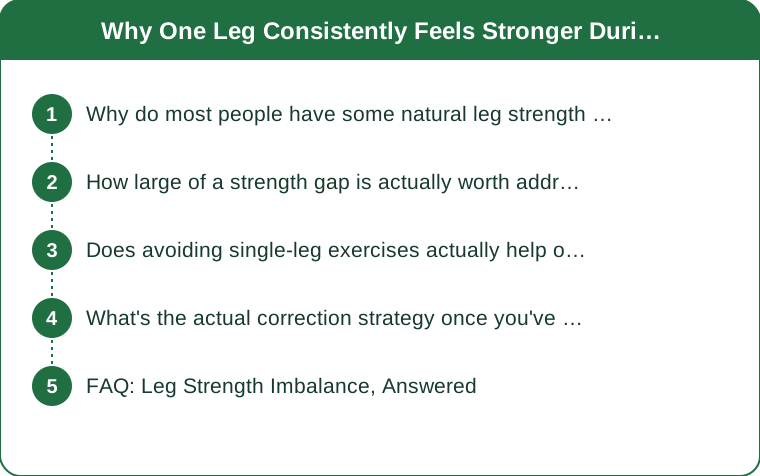
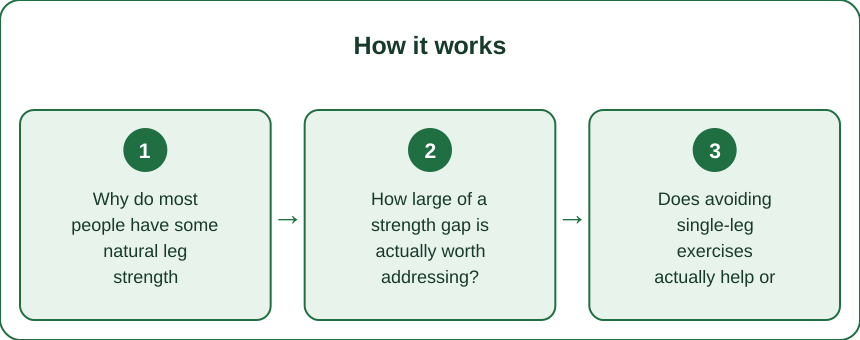
Why do most people have some natural leg strength asymmetry?
Dominant-side preference in everyday movement — favoring one leg for kicking, stepping up first, or standing weight distribution — builds small but real strength and coordination differences over years, well before any structured training begins. Some degree of asymmetry is close to universal rather than a sign of a specific problem.
The question isn’t whether any asymmetry exists, but whether it’s large enough to affect performance or raise injury risk meaningfully.
How large of a strength gap is actually worth addressing?
A noticeable difference in reps completed, form breakdown, or perceived effort at the same relative load between sides is generally the threshold worth training around — a very slight, barely perceptible difference usually isn’t worth restructuring a program over. Bilateral exercises alone tend to mask this gap since the stronger side can compensate, which is part of why single-leg work is valuable specifically for revealing it.
Tracking reps or load per side over a few sessions gives a clearer picture than judging by feel in a single workout.

Does avoiding single-leg exercises actually help or hurt an existing imbalance?
It hurts — avoiding unilateral work removes the main tool that isolates and directly trains the weaker side independently. Bilateral exercises like squats let the stronger leg compensate for the weaker one without you necessarily noticing, which can let a gap persist or even widen slowly over time without ever being addressed directly.
Single-leg training is uncomfortable specifically because it reveals the gap, but that same discomfort is what makes it the right tool for closing it.
What’s the actual correction strategy once you’ve identified a real gap?
Training the weaker side with slightly more volume or frequency — an extra set, or training it first in a session while it’s freshest — is a standard, effective approach, rather than reducing work on the stronger side to match. This closes the gap by bringing the weaker side up, which also avoids losing strength you’ve already built on the stronger side unnecessarily.
Reassessing every few weeks lets you scale back the extra volume once the gap has meaningfully closed, rather than continuing an imbalanced program indefinitely.
FAQ: Leg Strength Imbalance, Answered
Is a leg strength imbalance actually linked to injury risk?
Significant, persistent asymmetry is associated with increased injury risk in some research, particularly in sports involving repeated unilateral movement like running or jumping, making it worth addressing rather than ignoring.
How long does it typically take to close a real strength gap between legs?
Most people see meaningful improvement within 6-8 weeks of consistently prioritizing extra volume on the weaker side, though full parity isn’t always necessary or realistic.
Should I stop bilateral exercises entirely while correcting an imbalance?
No — keep bilateral exercises in your program for overall strength, just add targeted unilateral volume on the weaker side alongside them rather than replacing one with the other.
TL;DR:
- Some leg strength asymmetry is close to universal, tied to everyday dominant-side movement patterns
- A gap worth addressing shows up as a noticeable difference in reps, form, or effort at the same load
- Avoiding single-leg work hides the gap rather than closing it — bilateral exercises let the stronger side compensate
- Add extra volume or frequency to the weaker side rather than holding back the stronger one
A side-to-side strength gap isn’t a flaw to hide from single-leg exercises — it’s exactly the kind of gap those exercises are built to reveal and, with a bit of targeted extra work, close.
Keep Reading
This article is for general informational and styling purposes only. Fit, sizing, and product availability may vary.