Why Your Quads Take Over Every Leg Exercise You Do
Quick Answer: Quads dominate when the load line sits forward of your hips, when your shin angle tips forward, and when the movement is knee-driven rather than hip-driven. The four adjustments that shift work to the posterior chain: keep the shin more vertical, push the hips further back, shorten the range at the bottom where the glutes disengage, and slow the eccentric so the target muscle stays under tension. Feeling a muscle is not proof it is doing more work, so use position rather than sensation to judge.
You did Romanian deadlifts and your quads are sore. You did hip thrusts and felt your quads. You did split squats for glutes and your quads have opinions about it.
This is one of the most common frustrations in lower-body training and it usually comes down to three or four positional habits that repeat across every exercise.

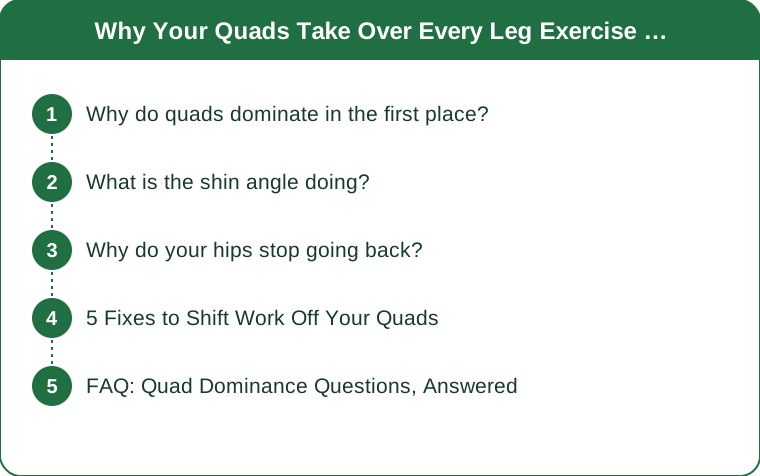
Why do quads dominate in the first place?
Because for most people they are the most practiced, most neurologically available muscle group in the lower body, and because everyday movement is knee-dominant.
Walking, stairs, standing from a chair, and cycling all bias the quadriceps. Hip extension under load, which is what the glutes and hamstrings are for, is comparatively rare outside of deliberate training.
The result is a default motor pattern. Given a task that could be solved by knees or hips, your body picks knees, because that is the pattern with the most reps behind it.
Then the sensation reinforces it. You feel the quads working, you conclude the exercise is a quad exercise, and you often adjust in a direction that makes it more so.
Worth stating clearly: sensation is a poor measure of muscular contribution. Muscles that are more fatigued, more damaged, or more accustomed to being noticed produce more sensation at the same workload. Judging your glute exercise by whether you feel your glutes is a genuinely unreliable method.
What is the shin angle doing?
It is the single biggest determinant of knee versus hip emphasis, and it is easy to see on video.
When the shin tips forward, the knee travels forward over the foot, the knee joint moment increases, and the quadriceps take a larger share. When the shin stays closer to vertical, the hips have to travel back to keep balance, which increases the hip moment and loads glutes and hamstrings.
Where this shows up:
- Squats. More forward knee travel means more quad. Sitting back with a more vertical shin shifts toward hips, at the cost of depth for most people.
- Split squats. A long stance with a vertical front shin is a glute exercise. A short stance with the knee well forward is a quad exercise. Same movement name, different exercise.
- Step-ups. Higher box and a more upright shin loads the glute. Lower box with the knee driving forward loads the quad.
- Lunges. Forward lunge is more quad-biased; reverse lunge is more hip-biased, largely because of where the shin ends up.
The practical test: film from the side. If your shin is more than about 25 degrees off vertical at the bottom of a movement you intended as hip-dominant, that is your answer.
One caveat: ankle mobility limits this. If you cannot keep the shin back without falling over, restricted ankle dorsiflexion may be forcing the pattern, and a heel elevation or an ankle mobility block is the fix rather than more cueing.

Why do your hips stop going back?
Because hinging requires you to move your center of mass backwards over your heels, and that feels like falling.
The compensation is to bend the knees instead, which keeps you balanced and converts a hinge into a squat. This is the most common technical error in Romanian deadlifts, good mornings, and kettlebell swings.
How to feel the difference:
- Stand about 15cm in front of a wall, facing away
- Push your hips back until your glutes touch the wall, keeping your knees only slightly bent
- Notice that your torso tips forward as a consequence, not as an action
That is a hinge. If your knees bend more than about 20 degrees to reach the wall, you squatted.
Cues that work better than push your hips back:
- Close a car door with your backside
- Keep your shins where they are and move your hips away from the bar
- Feel your weight shift toward your heels without lifting your toes
Range matters here too. In a Romanian deadlift, glute and hamstring tension is highest in the mid-range, and going deeper usually means rounding the back or bending the knees, both of which reduce the target loading. Stopping at the point where your hamstrings are stretched but your position is intact loads more, not less.
5 Fixes to Shift Work Off Your Quads
1. Elevate the front foot on hip-dominant exercises, not the heel. Heel elevation increases forward knee travel, which is useful when you want quads. For glutes, keep the heel down or slightly elevate the toes.
2. Lengthen your split squat stance. A stance that feels slightly too long is usually the one that loads the glute. Short stances are quad stances.
3. Slow the eccentric to 3 or 4 seconds. Fast lowering lets you use momentum and the stretch reflex, and the dominant muscle group absorbs it. Slow lowering keeps the target under tension where it works, and it is the most reliable single change for feeling a muscle you have not felt before.
4. Shorten the range where the target disengages. Below a certain depth in a hip thrust or an RDL, the glute mechanically loses its advantage and other muscles take over. Working the range where the target is strongest produces better stimulus than a bigger range with worse loading.
5. Pre-fatigue the target, briefly. One set of a simple isolation movement, hip abduction, glute bridge, or hamstring curl, before the compound lift raises awareness and the target’s contribution somewhat. Keep it light, since the goal is connection rather than fatigue.
And the honest caveat: quads doing a share of the work in a squat is correct. The problem is only a problem when a movement you programmed for hips is producing no hip stimulus at all. Do not chase a burn-free quad experience in every lift, because that is not how the lower body works.
Late-summer programming note: this is a good stretch of the year to fix positional habits, because most people are in a maintenance phase rather than pushing personal records. Positional changes temporarily reduce the load you can move, which is much easier to accept in August than in a peak block.
This is general information, not medical advice. Knee pain that changes with these adjustments is worth having assessed rather than working around.
FAQ: Quad Dominance Questions, Answered
Why do I feel my quads during glute exercises?
Usually a forward shin angle, insufficient hip travel backwards, or a fast eccentric. Quads are also the most practiced lower-body muscle group, so they are recruited by default when a movement could be solved either way.
Does feeling a muscle mean it is working hardest?
No. Sensation reflects fatigue, muscle damage, and familiarity as much as workload. Use position and video rather than sensation to judge which muscle group a movement is loading.
What is the fastest fix for quad dominance?
Slow the lowering phase to 3 or 4 seconds and lengthen your split squat stance. Both change the loading immediately without needing new exercises.
TL;DR:
- Quads dominate because everyday movement is knee-driven, so knee-bias is your default motor pattern under load.
- Shin angle is the biggest lever. More vertical shin means more hip, more forward shin means more quad, across every exercise.
- Hips stopping short is the hinge error. Use the wall drill to feel the difference between hinging and squatting.
- Slow the eccentric, lengthen the split squat stance, and work the range where the target is mechanically strongest.
Stop judging by sensation and film yourself from the side. Shin angle will tell you more in ten seconds than a month of chasing a burn.
Keep Reading
This article is for general informational and styling purposes only. Fit, sizing, and product availability may vary.