Why Your Adductors Decide Your Squat Depth
Quick Answer: The adductor group crosses the hip and restricts both flexion and abduction, which are the two motions a deep squat requires simultaneously. When depth is limited despite good ankle and hip flexor mobility, tight or weak adductors are the most likely remaining cause — and they respond better to loaded range work than to stretching.
You have done the ankle work. You have stretched your hip flexors until you are bored of it. You have watched every video about butt wink.
Your squat is still two inches short of where you want it, and it has been for a year.
There is a muscle group you probably have not looked at, and it sits in a position where it can quietly limit everything.

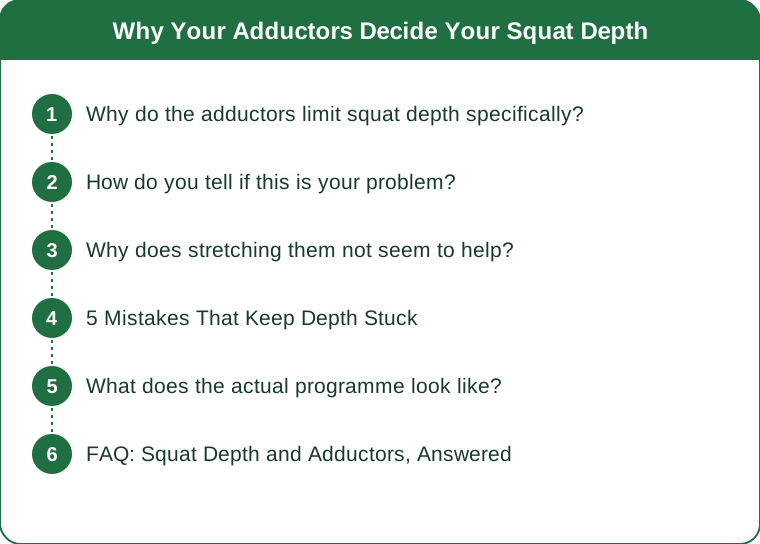
Why do the adductors limit squat depth specifically?
Because a deep squat needs hip flexion and hip abduction at the same time, and the adductors resist both.
The adductor group — adductor magnus, longus, brevis, gracilis and pectineus — runs from the pelvis to the femur along the inner thigh. Their primary job is adduction, pulling the leg toward the midline. But their line of pull also gives them roles in flexion and extension depending on the hip angle, and adductor magnus in particular is a powerful hip extensor whose posterior fibres behave almost like a hamstring.
A deep squat asks the hips to flex substantially while the knees track outward, which requires abduction and external rotation. That combination puts the adductors at their longest, and if their available length runs out, one of two things happens: your knees collapse inward to give the adductors slack, or your pelvis tucks under to find range elsewhere.
Both of those are the classic squat faults everyone tries to coach away at the wrong end. The knees-in and the butt wink are frequently symptoms of an adductor length limit rather than cues that were not followed.
How do you tell if this is your problem?
Two tests, five minutes, and they are unusually clear.
Test one — the wide stance comparison. Squat at your normal stance, note the depth. Then squat with a substantially wider stance and the toes turned out further. If depth improves noticeably, the limitation involves hip position and adductor length rather than ankles.
Test two — the frog stretch position. On all fours, knees wide, hips settling back. If you feel a strong stretch on the inner thigh well before your hips reach the back of your ankles, that is your adductors reporting for duty. Compare sides — asymmetry here is common and often explains a squat that shifts sideways under load.
For contrast: an ankle limitation shows up as heels lifting and torso pitching forward, and improves when you elevate the heels. A hip flexor or capsular limitation typically feels like pinching at the front of the hip rather than stretch on the inside.
If elevating your heels does nothing but widening your stance does a lot, you have your answer.
Why does stretching them not seem to help?
Because for most people it is not purely a length problem.
Passive stretching of the adductors produces a temporary increase in tolerated range that fades within about half an hour. If the tissue were genuinely short, that would still be a starting point. Often it is not short — it is poorly controlled at end range, and the nervous system limits the range because it cannot stabilise there.
This is a much more common situation than shortness, and it explains a familiar frustration: the frog stretch feels better afterwards, and your squat depth is unchanged the next session.
The intervention that works is loaded end-range strength, not passive length. Cossack squats, controlled adductor slides, wide-stance goblet squats with a pause in the bottom, and Copenhagen planks all ask the adductors to produce force in a lengthened position. That is what changes usable range rather than momentary range.
Expect four to six weeks before it shows in your squat. Passive stretching changes things in minutes and loses them in minutes; loaded work changes things in weeks and keeps them.

5 Mistakes That Keep Depth Stuck
1. Only training the squat. The squat is a test of hip range, not a builder of it. If it is limited, the fix happens in accessory work, not by squatting more.
2. Stretching before squatting rather than after. Aggressive static stretching immediately before heavy squatting can temporarily reduce force output and stability, which is the opposite of what you want under a loaded bar. Do range work after, or in a separate session.
3. Never training a wide stance. Most people squat one stance forever. Rotating in wide-stance and Cossack work exposes and develops the range the narrow stance never asks for.
4. Ignoring one side. Adductor asymmetry is extremely common and shows up as a hip shift at the bottom of a squat. If you never train unilaterally, you never see it and never fix it.
5. Chasing depth with load on the bar. Adding weight to a squat you cannot control at depth teaches your body to avoid the depth. Build the range at light load and let heavy squats follow it.
What does the actual programme look like?
Three exercises, twice a week, ten to twelve minutes. This is not a large time commitment and it is the reason it works.
Cossack squats. Wide stance, shift onto one bent leg while the other stays straight, sit as low as control allows, return. Three sets of six each side. Hold a light weight at the chest once bodyweight is comfortable — the counterbalance genuinely lets you sit deeper, which is the point.
Wide-stance goblet squats with a paused bottom. Three sets of eight with a three-second pause at your lowest controlled position. Actively push the knees out during the pause. This is where end-range control is built.
Copenhagen planks. Side plank with the top leg supported on a bench, holding the position with the inner thigh. Start with the knee supported rather than the ankle. Three sets of 15 to 20 seconds each side. Brutal for the first fortnight, then unremarkable.
Optional, if asymmetry is present: an extra set on the restricted side, always trained first.
Track it properly. Film your squat from the front and side at the start, then again at four weeks. Depth changes are gradual and genuinely hard to feel, and most people underestimate their own progress without the comparison. Any sharp groin pain rather than stretch or effort is a reason to stop and get it checked. This is general information, not medical advice.
FAQ: Squat Depth and Adductors, Answered
Do I actually need to squat below parallel?
Not necessarily. Depth is useful for range and for certain sports, but a well-executed parallel squat builds plenty of strength. Chase depth because you want the range, not because a number on the internet said so.
Can foam rolling the inner thigh help?
It can reduce the sensation of tightness for a short window, which makes the loaded work more comfortable. Treat it as a warm-up tool rather than as the intervention.
Why does my depth vary so much day to day?
Sleep, temperature, prior training and how long you sat that day all affect it. Late-summer heat genuinely helps; a cold gym in October genuinely does not. Judge progress across weeks rather than sessions.
Is knee cave always an adductor issue?
No — hip abductor weakness is the other major cause, and the two often coexist. If widening your stance does not help but band-resisted abduction work does, the limitation is on the other side of the equation.
TL;DR:
- A deep squat requires hip flexion and abduction simultaneously, and the adductors resist both at end range.
- Knee cave and pelvic tuck are frequently adductor length limits rather than coaching failures.
- Passive stretching produces temporary range; loaded end-range work produces usable range in four to six weeks.
- Cossack squats, paused wide-stance goblets and Copenhagen planks are the whole programme.
Run the wide-stance test at the start of your next session. If depth improves immediately, you have found the thing a year of ankle mobility work was never going to fix.
Keep Reading
This article is for general informational and styling purposes only. Fit, sizing, and product availability may vary.