Why Your Hamstrings Never Feel Anything During Leg Day
Quick Answer: Hamstrings are lengthened and loaded through hip flexion with a relatively fixed knee. If you’re feeling everything in your quads, it’s usually one of four things: you’re bending your knees instead of hinging your hips, your range is too short, the load is too heavy to control the eccentric, or you’re rushing the lowering phase. Fix the hinge first — most people’s “hamstring exercises” are quarter-squats with a barbell.
You’ve done Romanian deadlifts for months and your hamstrings have never once been sore. That’s not a genetics problem.

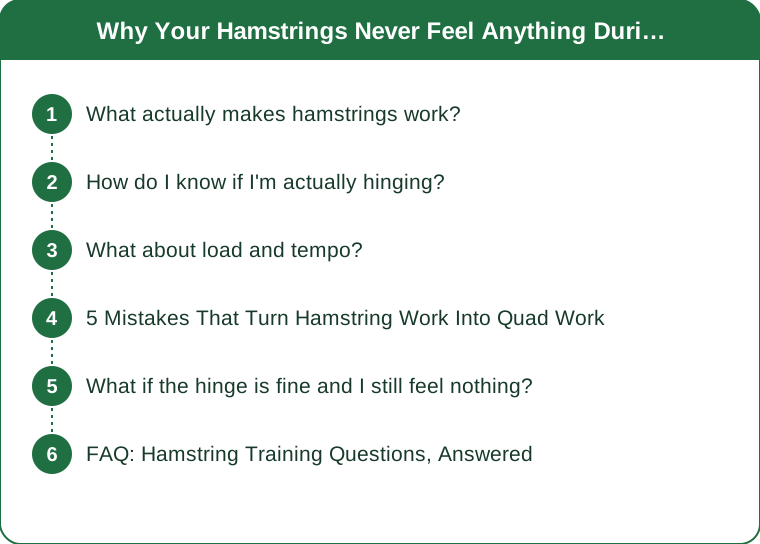
What actually makes hamstrings work?
Two functions — hip extension and knee flexion — and most people only train one badly.
The hamstrings cross two joints. They extend the hip and they flex the knee. Most leg-day movements target the hip extension function.
For hip extension to load them, the hip has to travel through meaningful range while the knee stays relatively fixed. The moment the knee starts bending significantly, the movement becomes a squat and the quads take over.
That’s the entire mechanism behind “I don’t feel my hamstrings.” The knee is bending when it should be holding.
Stretch under load is what produces the sensation people are looking for. The hamstrings lengthen as the hips travel back and the torso comes forward — and if the torso isn’t traveling far, they aren’t lengthening much.
Curl-type movements train knee flexion separately, and most quad-dominant lifters do very little of it. Both functions deserve training.
How do I know if I’m actually hinging?
Three checks, all easy to self-assess.
Where do your hips go? In a hinge, hips travel backward substantially — think of pushing a door closed behind you with your glutes. In a squat, hips travel down. Film yourself from the side; the difference is unmistakable on video and invisible from the front.
Does your shin stay vertical? In a proper hinge the shin barely moves from vertical. If your knees are traveling forward, you’re squatting.
Do you feel a stretch behind the thigh at the bottom? This is the direct feedback. No stretch means no lengthening, which means minimal loading.
Test without weight first. Stand with feet hip width, put your hands on the crease of your hips, push your hips straight back while keeping a soft-but-fixed knee angle. Go until you feel the stretch. That’s your range — and for most people it’s less than they assumed, which is fine.
Wall drill: stand a foot from a wall, facing away, and hinge until your glutes touch it. Then step further away and repeat. This teaches the backward hip travel better than any verbal cue.
What about load and tempo?
Too heavy is the second most common cause, and it’s counterintuitive.
A load you can’t control forces compensation. You’ll shorten the range, bend the knees, or rush the lowering — all three remove the hamstrings from the movement.
Romanian deadlifts are a control exercise, not a max-effort one. Most people get far more from moderate load with a full 3-second lowering than from heavy load moved quickly.
The eccentric is where hamstrings do their most valuable work. Lowering under control through a full range is the specific stimulus — and it’s also where the protective effect against hamstring strains comes from in the research.
Try this: cut your working weight by 40%, take 4 seconds to lower, pause 1 second at your deepest controlled position, then return. 6 to 8 reps. Most people feel their hamstrings for the first time.
Then rebuild the load slowly, keeping the tempo. If tempo breaks down, the weight is too heavy regardless of what the number says.

5 Mistakes That Turn Hamstring Work Into Quad Work
1. Bending the knees to reach lower. The most common one. Depth should come from hip travel and hamstring flexibility, not from bending the knees. Shorter range with a correct hinge beats deeper range with a squat.
2. Starting the movement by bending the knees. The first movement should be the hips traveling back. If your knees move first, the pattern is a squat from rep one.
3. Rounding the lower back to get more range. This substitutes spinal flexion for hip flexion, removes the hamstring stretch, and loads the spine. Stop where you can hold a neutral spine — that’s the honest end of your range.
4. Never training knee flexion. Leg curls, nordic curls, and slider curls train a function that hinges don’t. Skipping them leaves half the muscle undertrained.
5. Doing hamstring work last, exhausted. After heavy squats you have neither the control nor the attention for a technical hinge. Move it earlier in the session, or give it its own day.
What if the hinge is fine and I still feel nothing?
Then look at mobility, and at whether you’re actually reaching the stretched position.
Limited hamstring flexibility caps your available range. If you can only hinge 45 degrees before your back rounds, that’s your working range — and the muscle isn’t reaching a strongly loaded lengthened position.
Improve it with loaded stretching rather than passive stretching. Deficit RDLs from a low platform, or single-leg RDLs which allow more hip range, tend to build range and strength together.
Single-leg variations solve a lot of this and expose asymmetry at the same time. A single-leg RDL with a light dumbbell often produces more hamstring sensation than a heavy bilateral one.
Check glute involvement. Very glute-dominant hinges can leave hamstrings underworked, particularly with a wider stance and more upright torso. A narrower stance with more forward torso travel shifts emphasis toward hamstrings.
And accept that sensation isn’t the goal — loading is. You can train a muscle effectively without a strong burn. If your hinge is technically sound, the range is full, and the eccentric is controlled, the hamstrings are working whether or not you feel it dramatically.
This is general information, not medical advice.
FAQ: Hamstring Training Questions, Answered
Should I feel a stretch or a burn?
Stretch during hinges, burn during curls. They train different functions and produce different sensations. If a hinge produces only burn and no stretch, range is likely too short.
How often should I train hamstrings?
Twice a week works well for most people, with hip-extension work one day and knee-flexion work another, or both in each session. They recover reasonably fast but heavy eccentric work can produce soreness lasting several days, especially at first.
Are nordic curls worth the difficulty?
They have strong support for building eccentric hamstring strength and reducing hamstring strain risk in athletes. They’re also genuinely hard — most people need a long regression progression starting with band or partner assistance and a very small range.
Why are my hamstrings always tight?
Tightness often reflects a strength or control issue rather than a length issue — a muscle working at the edge of its capacity feels tight. Many people find that strengthening through a full range does more for the sensation of tightness than stretching does.
TL;DR: If your hamstrings never feel anything, your hinge is probably a squat.
- Hips travel backward, shin stays vertical, knee angle stays fixed. Film it from the side.
- The stretch behind the thigh is the feedback. No stretch = no meaningful loading.
- Too heavy is the second cause. Cut 40%, take 4 seconds down, pause 1 second, 6 to 8 reps.
- The eccentric is the point — controlled lowering through full range is where the value is.
- Don’t round the back to get deeper. That trades hamstring stretch for spinal load.
- Train knee flexion separately — curls do something hinges don’t.
Move hamstring work earlier in the session. After heavy squats you have neither the control nor the attention for a technical hinge.
Keep Reading
This article is for general informational and styling purposes only. Fit, sizing, and product availability may vary.