Why Your Legs Feel Destroyed After Every Workout but Barely Change Shape
Quick Answer: Burn and next-day soreness come from metabolic byproducts and muscle damage — neither is the primary driver of muscle growth. Growth is driven mainly by mechanical tension: sufficient load, moved with control, taken close to failure. Fast, light, high-rep sets maximise the sensations and minimise the stimulus. Fix it by slowing the lowering phase to 2–3 seconds and adding load, using the same exercises you already do.
You finish leg day genuinely wrecked. Walking down stairs is a negotiation for two days. The burn during the sets was unbearable.
And six months later your legs look basically the same.
This is one of the most common and most frustrating patterns in training, and the explanation is simple once you separate two things people assume are the same thing: how hard a workout feels and what stimulus it delivers.

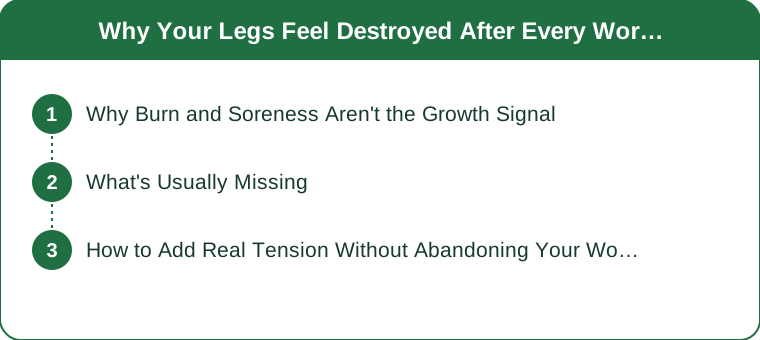
Why Aren’t Burn and Soreness the Growth Signal?
They’re real signals. They’re just measuring something else.
The burn is metabolic. During hard sets, byproducts including hydrogen ions accumulate faster than your body clears them, and the resulting drop in muscle pH is what you feel. It tells you that a set was metabolically demanding. It does not tell you that the muscle fibres experienced high tension.
The soreness — delayed onset muscle soreness, DOMS — comes mainly from mechanical disruption to muscle fibres, and it’s heavily influenced by novelty. Do an exercise you’ve never done and you’ll be crippled. Do the same exercise weekly for a month and the soreness largely disappears while the muscle keeps growing. Soreness tracks unfamiliarity far more closely than it tracks effectiveness.
What actually drives hypertrophy is mechanical tension — muscle fibres generating high force, under load, through a range of motion, with sets taken near enough to failure that the high-threshold motor units get recruited.
Here’s the key point: you can produce a lot of burn and soreness with very little tension. Fast bodyweight squats for 60 reps will torch your quads and leave you sore. They won’t load them meaningfully.
What’s Usually Missing From These Workouts?
Three things, and they travel together.
Load is too light. The most common version is a program built around high-rep, low-load work — 20+ reps with weight you could do 40 with if you had to. The metabolic demand is enormous, the tension per rep is modest.
Reps are too fast. Bouncing out of the bottom of a squat uses stored elastic energy and momentum to get through the hardest part of the movement — which is exactly the part where tension should be highest. The muscle skips the work.
The lowering phase is thrown away. Most people lower in well under a second, treating it as the boring part between reps. The eccentric portion is where a large share of the growth stimulus lives, and it’s being given away for free.
Put those together and you get the signature workout: fast, light, high-rep, brutal to experience, weak as a stimulus. It feels maximally hard, which is precisely why it’s so hard to diagnose from the inside.

How Do You Add Real Tension Without Starting Over?
You don’t need a new program. You need to change how you execute the one you have.
1. Slow the lowering phase to 2–3 seconds
This is the highest-leverage change available and it costs nothing. Count it. On a squat, three seconds down, brief pause, drive up with control.
Your first session doing this will feel humbling — the weight you were using suddenly isn’t manageable, which is the whole point.
2. Add load, then keep adding it
Move into the 6–12 rep range for your main leg movements, with a weight that makes the last two reps genuinely difficult. Then add a small increment when the top of that range gets comfortable.
Progressive overload is the mechanism. Same exercises, more weight over time, tracked in writing.
3. Eliminate the bounce
Pause for a beat at the bottom of squats, lunges, and leg presses. This removes elastic rebound and forces the muscle to generate force from a dead stop — a large increase in tension for zero extra weight.
4. Take sets close to failure
Leave roughly 1 to 3 reps in reserve on your working sets. Sets stopped well short of that recruit fewer of the fibres with the most growth potential. You don’t need to hit failure every set; you do need to be near it.
5. Cut the junk volume
Six exercises for quads at light weight is worse than three done properly at real load. Fewer, heavier, more controlled sets is the trade.
6. Expect less soreness, and don’t panic
As you make these changes and repeat the same movements weekly, soreness will decrease. That is not a sign of a weaker workout. It’s the repeated bout effect, and it’s normal.
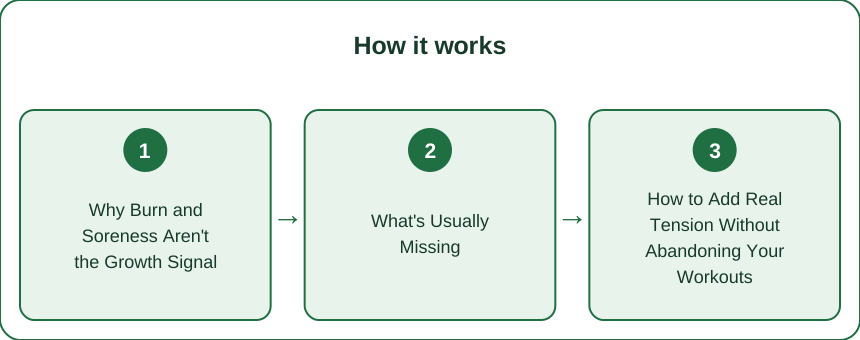
What Nobody Tells You About Leg Growth
Legs need volume, not just intensity. Roughly 10–20 hard sets per muscle group per week is the commonly cited effective range. Two hard sets of squats weekly won’t do it regardless of how heavy they are.
Recovery is part of the stimulus. Muscle is built between sessions. Training legs hard four times a week while sleeping six hours and undereating protein produces fatigue, not growth.
Protein and calories are non-negotiable. Around 1.6g of protein per kg of bodyweight daily, and enough total energy. Training for growth in a significant deficit is pushing against the brakes.
Legs are slow. Visible change in leg shape takes months, and progress photos every 8 weeks are a far better gauge than the mirror, which updates its baseline daily.
Track the numbers, not the feeling. If the weight on the bar hasn’t moved in three months, the program isn’t working — regardless of how destroyed you feel afterwards. That log is the only honest witness you have.
If you have joint pain, existing injuries, or you’re new to loaded lifting, get form checked by a coach or physiotherapist before adding significant weight. Slow eccentrics under load are effective and unforgiving of poor technique.
FAQ
Does soreness mean I had a good workout?
No. Soreness mostly reflects how unfamiliar the movement was. Experienced lifters making excellent progress are often barely sore, because their bodies have adapted to the exercises while the muscles keep responding to increasing load.
Should I stop doing high-rep sets entirely?
Not at all — higher-rep work taken near failure does build muscle, and it’s useful for volume and joint-friendly loading. The problem isn’t high reps; it’s high reps with light load, fast tempo, and sets stopped short of real effort.
How long before I see leg growth?
With adequate load, volume, protein, and recovery, most people see visible change in 3 to 4 months. Legs carry a lot of muscle mass, so proportional change takes longer to become obvious than it does on arms or shoulders.
TL;DR:
- Burn is metabolic, soreness is novelty — neither is the growth signal
- Growth comes from mechanical tension: real load, controlled, near failure
- Fast light high-rep sets maximise sensation and minimise stimulus
- Slow the lowering to 2–3 seconds — the single highest-leverage fix
- Work in the 6–12 rep range, add load over time, pause at the bottom
- Aim for 10–20 hard sets per muscle per week, 1.6g/kg protein, real sleep
- Judge by the logbook, not by how destroyed you feel
Keep Reading
This article is for general informational and styling purposes only. Fit, sizing, and product availability may vary.