Why Your Legs Feel Completely Worked But Don't Look Any Different
Quick Answer: Feeling sore doesn’t mean a muscle is being progressively overloaded — soreness mostly reflects unfamiliar movement or volume, while visible muscle growth requires progressive resistance over time, so a consistently sore but unchanging routine usually means the same weight and reps are being repeated without real progression.
Soreness feels like proof a workout worked, but it’s a poor stand-in for the actual driver of visible change: progressive overload over weeks and months.

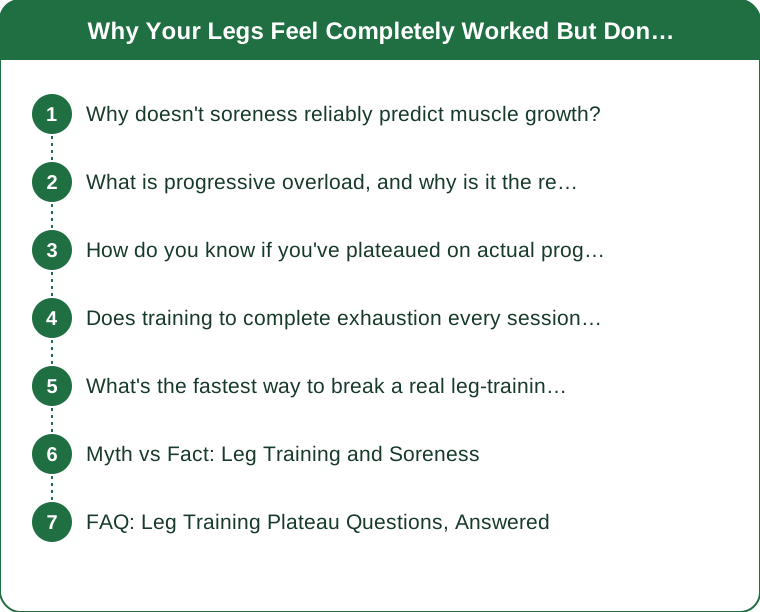
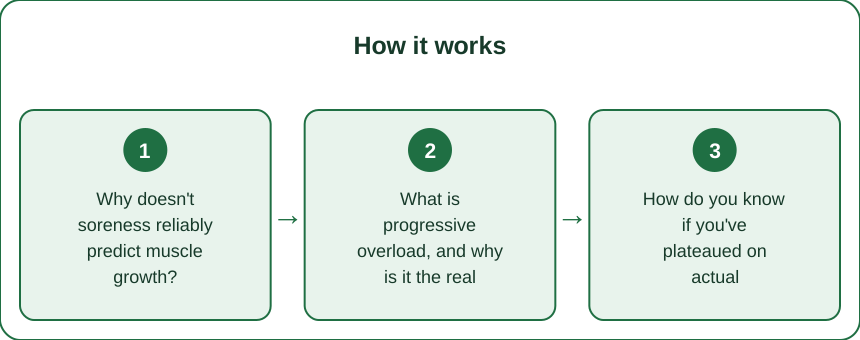
Why doesn’t soreness reliably predict muscle growth?
Soreness — technically delayed onset muscle soreness — comes mostly from unfamiliar movement patterns or a spike in volume, which is why a new exercise or class makes you sore even at a light weight. Once your body adapts to a movement over a few weeks, soreness naturally decreases even as the exercise continues to build strength and size, which is why ‘no longer sore’ gets mistaken for ‘no longer working.‘
What is progressive overload, and why is it the real driver of visible change?
Progressive overload means gradually increasing weight, reps, or difficulty over time, forcing muscles to adapt to a demand slightly beyond what they’re used to. Repeating the exact same weight and rep scheme for months, even with perfect soreness every session, gives muscles no reason to grow further once they’ve adapted to that specific load.
How do you know if you’ve plateaued on actual progression, not just soreness?
Check your training log: if the weight, reps, or difficulty level hasn’t meaningfully increased in 6-8 weeks, that’s the real plateau signal, regardless of how sore sessions feel. Many people keep a mental sense of effort but don’t track actual numbers, which hides a stalled progression that soreness alone would never reveal.

Does training to complete exhaustion every session actually help more than progression does?
Not necessarily — training to failure or extreme fatigue every session without increasing the actual load produces plenty of soreness and exhaustion but doesn’t guarantee more growth than moderate effort with consistent progression. Muscles respond to the total demand placed on them over time, not to how depleted you feel walking out of the gym that day.
What’s the fastest way to break a real leg-training plateau?
Start tracking exact weights and reps for your main leg exercises, and commit to increasing at least one variable every 1-2 weeks, even by a small amount (2.5-5 lbs, or one extra rep per set). This single change — tracking and deliberately progressing — does more for visible results over 8-12 weeks than any amount of extra soreness from repeating the same session.
Myth vs Fact: Leg Training and Soreness
Myth — if you’re not sore, the workout didn’t work. Fact — soreness fades as your body adapts to a movement, even while that movement continues to build strength; lack of soreness isn’t lack of progress. Myth — training harder always means training better. Fact — progressive overload over weeks matters more than how exhausted or sore any single session leaves you.
FAQ: Leg Training Plateau Questions, Answered
How often should leg training weight or reps actually increase?
A small increase every 1-2 weeks is a reasonable target for most people, though some weeks may hold steady while form or recovery catches up.
Is it normal to stop getting sore from a workout you’ve done for months?
Yes, this is expected as your body adapts, and it doesn’t mean the workout has stopped being effective as long as progression continues.
Should you switch exercises entirely if you’ve plateaued?
Switching exercises can help by introducing a new stimulus, but tracking and progressing weight or reps within your current exercises usually solves the plateau without needing a full routine change.
TL;DR:
- Soreness reflects unfamiliar movement, not ongoing progressive overload
- Visible muscle change requires actually increasing weight, reps, or difficulty over time
- A 6-8 week check of your training log reveals a real plateau better than how sore you feel
- Small, consistent increases in load matter more than training to exhaustion every session
Stop using soreness as your progress metric — track the actual numbers, and increase them steadily, and the visible change follows.
Keep Reading
This article is for general informational and styling purposes only. Fit, sizing, and product availability may vary.