Why Your Second Leg Day of the Week Usually Feels Stronger Than the First
Quick Answer: The first session of a training week carries the most residual stiffness, the least recent movement practice, and often the worst sleep behind it. By the second session your nervous system has rehearsed the patterns, soreness has resolved, and joints are moving better - a real and measurable effect. Use it by putting your hardest work in the second session rather than the first.
Monday feels like wading and Thursday feels like lifting.
The difference is not in your head, and once you know why, the sensible response is to rearrange the week rather than to fight it.

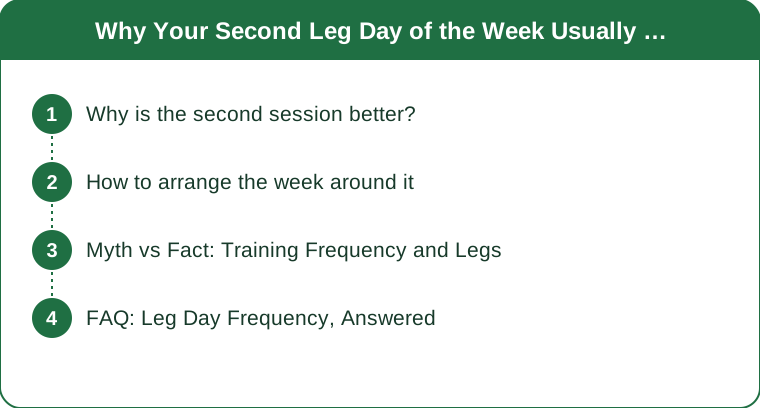
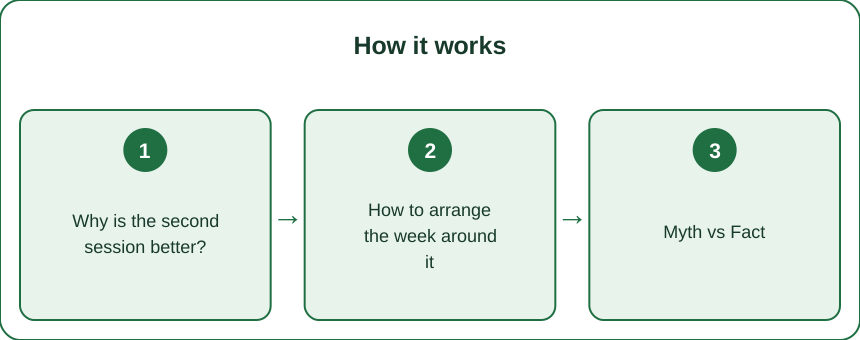
Why is the second session better?
The repeated bout effect is real and well documented. After a session that causes muscle damage, the next similar session produces less damage, less soreness, and better performance - and the protective effect appears quickly.
Motor patterns are more recent. Squatting on Thursday when you last squatted on Monday means the coordination is fresh, whereas Monday follows a weekend of no squatting at all.
Residual stiffness is usually lower. Most people are stiffest after their least active period, which for the majority is the weekend, and the first session of the week absorbs that.
Joint preparation carries over. Synovial fluid movement and connective tissue response to loading persist for days, so a joint loaded on Monday is genuinely better prepared on Thursday.
And the psychological load is different. The first session of a week carries the whole week’s expectation; by the second, you already have evidence that you can do it.
One caveat worth naming: if your second session is consistently worse rather than better, that is a recovery problem rather than a scheduling one, and it points to too little time or too much volume between the two.
How to arrange the week around it
Put your heaviest or most technical work in the second session. If you squat twice a week, the second one should carry the top sets, because that is where the movement quality is highest.
Use the first session to prepare rather than to peak. Moderate load, more volume, more accessory work - it primes the pattern for the session that matters.
Keep 72 hours between them where possible. Two to three days is usually enough for recovery while remaining close enough to keep the repeated bout benefit, and a five-day gap starts losing it.
Do not simply repeat the session. Same movements, different emphasis - the first heavier on volume and single-leg work, the second heavier on load - avoids the monotony that stalls progress.
Add a short movement session on the day before your first hard day. Twenty minutes of easy loading on Sunday removes most of the Monday stiffness that the effect is compensating for anyway.
Track which session your PBs actually happen in. If they cluster in one, that is your evidence, and it is worth more than any general rule about scheduling.

Myth vs Fact: Training Frequency and Legs
Myth: legs need a full week to recover. Fact: for most training loads, 48 to 72 hours is sufficient, and twice-weekly leg training generally outperforms once-weekly for both strength and size at matched volume.
Myth: soreness means you are not recovered. Fact: soreness and readiness are only loosely related. You can be sore and perform well, or feel fine and be under-recovered - which is why performance is the better marker.
Myth: the first session should be the hardest because you are freshest. Fact: freshest in terms of days off is not the same as best prepared. The second session usually has better movement quality.
Myth: if the second session feels easy, you did not work hard enough in the first. Fact: feeling better is the expected adaptation, not evidence of a wasted session.
Myth: you should train legs when you feel like it. Fact: consistent spacing produces the repeated bout benefit; scattered sessions do not, because the protective effect fades over roughly a week.
Myth: this applies equally to every exercise. Fact: it is strongest for movements with a large eccentric component - squats, lunges, and Romanian deadlifts - and much weaker for machine-based or concentric-dominant work.
FAQ: Leg Day Frequency, Answered
How many days should I leave between leg sessions?
Usually two to three. That is enough for recovery while staying close enough to retain the repeated bout benefit, which starts fading beyond about a week.
Should my hardest session be first or second in the week?
Second, for most people. Movement quality and joint preparation are better then, and the first session serves well as preparation rather than as a peak.
Why is my first session always stiff?
Because it follows your least active period, usually the weekend. Twenty minutes of easy loading the day before removes most of it.
Is twice a week better than once for legs?
Generally yes at matched weekly volume, for both strength and muscle. Splitting the same total across two sessions allows better quality in each.
What if my second session is consistently worse?
That points to insufficient recovery - either too little time between them or too much volume in the first. Reduce the first session’s volume before changing the spacing.
Does this apply to all exercises?
Most strongly to movements with a big eccentric component like squats, lunges, and Romanian deadlifts. Machine work and concentric-dominant lifts show far less of the effect.
Should I match the two sessions exactly?
No - same movements with different emphasis works better. Volume and single-leg work in the first, heavier top sets in the second.
TL;DR:
- The repeated bout effect makes a second similar session produce less damage and better performance, and it is well documented.
- Your first session of the week also carries the most residual stiffness and the least recent movement practice.
- Put your heaviest and most technical work in the second session, and use the first to prepare rather than to peak.
- Keep roughly 72 hours between them - closer than a week keeps the benefit, and two to three days allows recovery.
- Soreness and readiness are only loosely related; performance is the better marker.
If your second session is consistently worse rather than better, that is a recovery problem - cut volume in the first before changing the spacing.
Keep Reading
This article is for general informational and styling purposes only. Fit, sizing, and product availability may vary.